
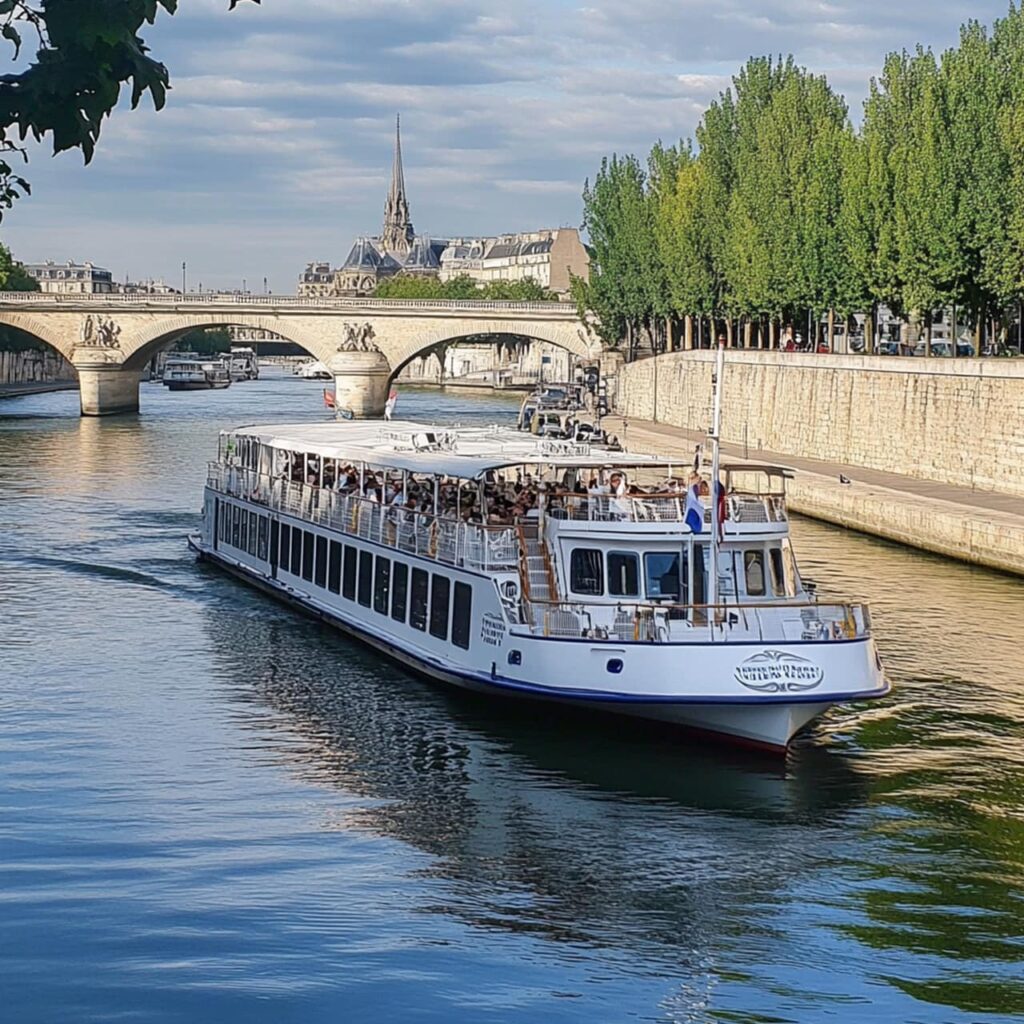
Seine River Cruise Tickets
Reserve your seat on board now and experience Paris from a unique perspective! Tickets sell out easily, especially in the evening.
You can cancel up to 24 hours before your visit
A cruise on the Seine is truly the perfect way to discover Paris from a unique and enchanting perspective.
As you glide along this historic river, you can take in the iconic sights of the French capital in a relaxed and surprising way.
Forget the hustle and bustle of traffic and crowds of tourists: the Seine offers you a remarkably privileged vantage point from which to enjoy the city at leisure.
Whether you are a first-time visitor or a true regular of the Ville Lumière, a cruise on the Seine is an experience not to be missed. Bathed in the magic of the sunset or illuminated by the night lights, the cruise turns into a romantic journey, suitable to be experienced alone, as a couple, or in good company.
Not only does it offer comfort, but it gives you spectacular views without the excessive waiting or exhausting walking.
In just a few hours, you will traverse centuries of history, art and culture. You will witness architectural masterpieces and symbolic sites that make Paris one of the world’s most beloved cities: you will have the opportunity to see iconic monuments such as the Eiffel Tower and Notre-Dame, alongside lesser-known treasures such as the Petit Palais or the Institut de France.
Choosing a cruise on the Seine is not just about seeing the city, but immersing yourself in its spirit and ancient history. It is the most magical and fascinating way to appreciate Paris in all its magnificent essence.
What can you see on the Seine cruise? The 18 attractions
Eiffel Tower
The symbol of Paris
ID 104941720 © Kmiragaya | Dreamstime.com
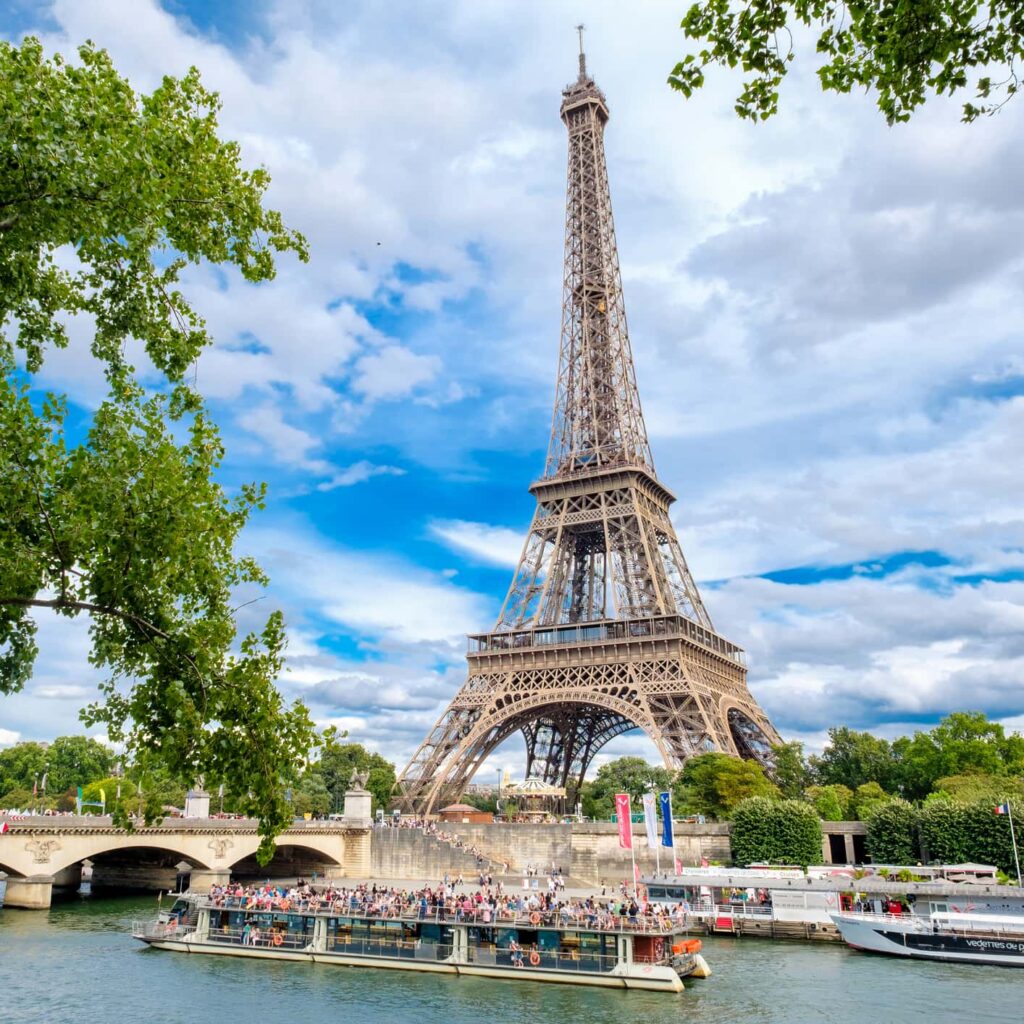
Any trip to Paris becomes complete only when admiring the grand Eiffel Tower, an unmistakable symbol of France. Since its inauguration in 1889 for the Universal Exposition in celebration of the centenary of the French Revolution, the tower, designed by engineer Gustave Eiffel, has fascinated the world.
At a majestic 324 meters, the Eiffel Tower was the tallest structure on the planet until 1929 and continues to be a favorite destination for millions of visitors. Nothing beats its grandeur when you join a cruise on the Seine. The tower springs up sublimely along the banks, especially near the Champs de Mars. As you sail, you can enjoy breathtaking views, especially from the Pont d’Iéna, from which its entire wrought-iron architecture is revealed in all its glory.
But when evening approaches, the Eiffel Tower is transformed: in fact, as the sun goes down, its golden lights thrill and enchant the eyes of spectators enchanted by the spectacle. Every hour, suddenly, thousands of tiny lights begin to shine, creating a play of sparks that looks even more enchanting from the river. Watching it in the silent atmosphere of the Seine is a magical experience.
During the cruise, you will have the opportunity to admire and photograph the tower from the calm of the river, away from the tourist crowds.
The Eiffel Tower is not only beauty, but also a symbol of technological advancement. Introduced at a time when metal structures were revolutionary, it has overcome criticism and is now one of the world’s most beloved pieces of architecture. Just imagine: more than 7 million people climb to the top each year to admire a breathtaking view of the city.
The Eiffel Tower from the Seine
Boating on the river offers an opportunity to appreciate the Eiffel Tower from unique perspectives. You will be able to lose yourself in its technical details without the stress of queues, basking in the beauty of the Dame de Fer as the boat slowly glides over the Seine. Finally, at night, the lights of the tower are reflected in the water composing a spectacle that you will hardly be able to forget.
Trocadéro
The monumental gardens of Paris
ID 69832271 @ Ioan Florin Cnejevici | Dreamstime.com
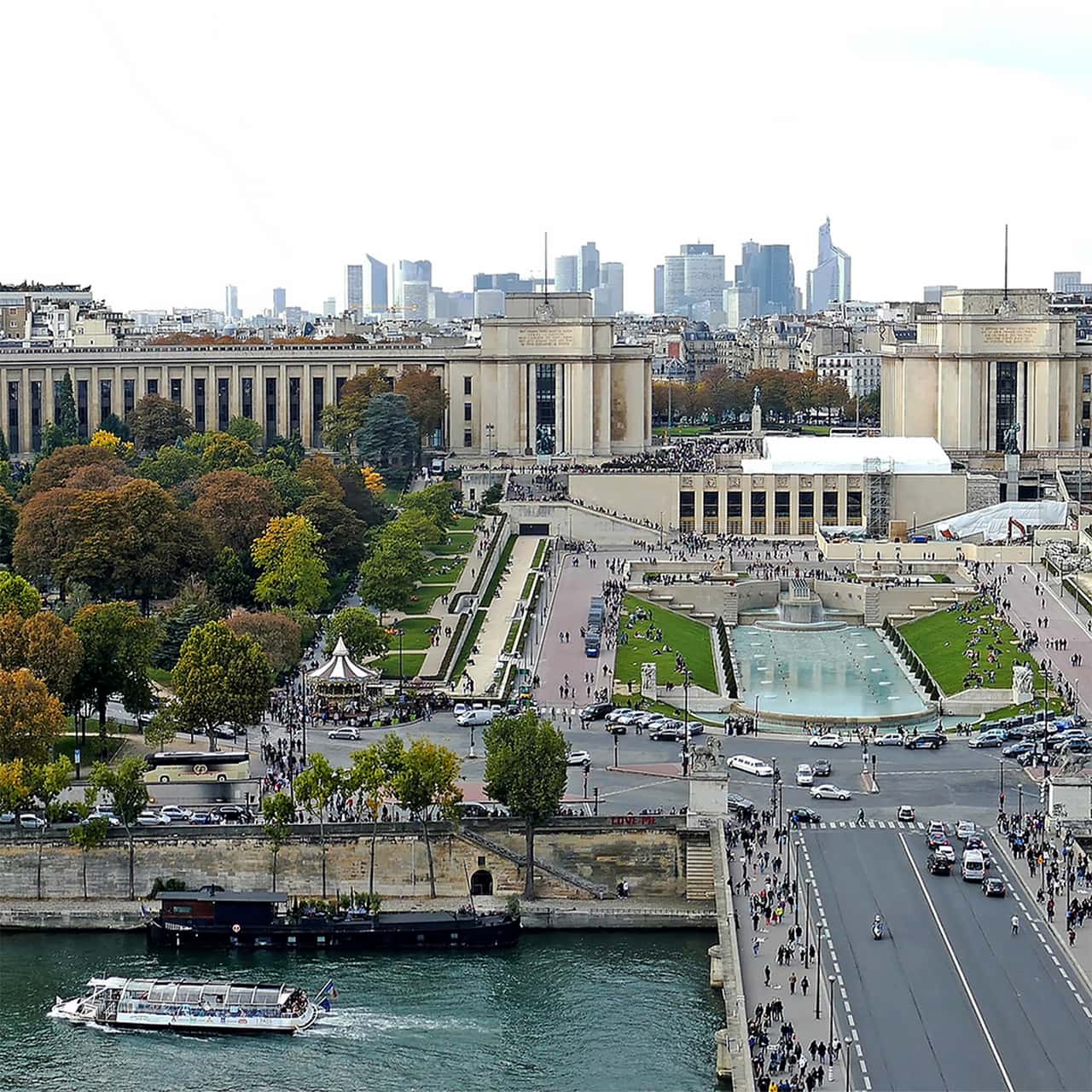
Located on the right bank of the Seine, directly opposite the Eiffel Tower, the Trocadero is one of the most striking and photographed spots in Paris. With its extensive gardens, monumental fountains and architecture, it offers a breathtaking view of the Eiffel Tower. An unmissable stop during a cruise on the Seine.
The history of the Trocadero is intertwined with important events. The name comes from the 1823 battle where French forces won over Spanish rebels near Cadiz. The Trocadéro Palace was erected to commemorate this victory during the 1878 Universal Exposition. In 1937, for the International Exposition of Arts and Techniques, the old palace was replaced by the modern Palais de Chaillot, designed by noted architects Léon Azéma, Jacques Carlu, and Louis-Hippolyte Boileau.
The Palais de Chaillot, the beating heart of the Trocadero, with its curved wings frames the gardens and offers a spectacular view of the Eiffel Tower. It is home to the Musée de la Marine, Musée de l’Man, and the National Theater of Chaillot known for its dance productions.
The Trocadero Gardens, below the Palais de Chaillot, cover a vast area with terraces, sculptures and impressive fountains. The main one is the Warsaw Fountain, with spectacular jets of water reflecting in the basin. During the day, it is a great place to stroll; at night, the lights transform the area into an enchanting setting, perfect for those sailing the Seine.
Passing in front of the Trocadero during a cruise on the Seine is a unique experience. From here, the view of the steps towards the Eiffel Tower is spectacular. Admiring gardens and fountains from an angle away from the crowds amplifies the magical effect, especially at sunset. Night adds an enchantment all its own, with the lights of the Eiffel Tower and Trocadéro creating an almost mystical atmosphere.
The Trocadéro offers more than a view: it is a mix of history, art, and nature in the heart of Paris. With its strategic location, wide green spaces, and monuments, it is the ideal place to enjoy the Eiffel Tower.
The Trocadéro from the Seine
One of the most exciting moments of a cruise on the Seine is the passage in front of the Trocadero. From this vantage point, the view of the wide stairways stretching toward the Eiffel Tower is truly spectacular.
The cruise allows you to admire the gardens and fountains of the Trocadéro from a unique vantage point, away from the crowds, and to capture in a single glance the perfect symmetry between the Trocadéro and the Eiffel Tower.
The view from the Seine is particularly striking at sunset, when the warm colors of the sky are reflected on the river waters and the shimmering surfaces of the fountains. At night, the illumination of the Eiffel Tower, combined with that of the Trocadéro, creates an almost magical atmosphere, making this point of the cruise one of the most photographed and appreciated.
Quai Branly Museum
The Ethnological Museum of Paris
ID 69832271 @ Ioan Florin Cnejevici | Dreamstime.com
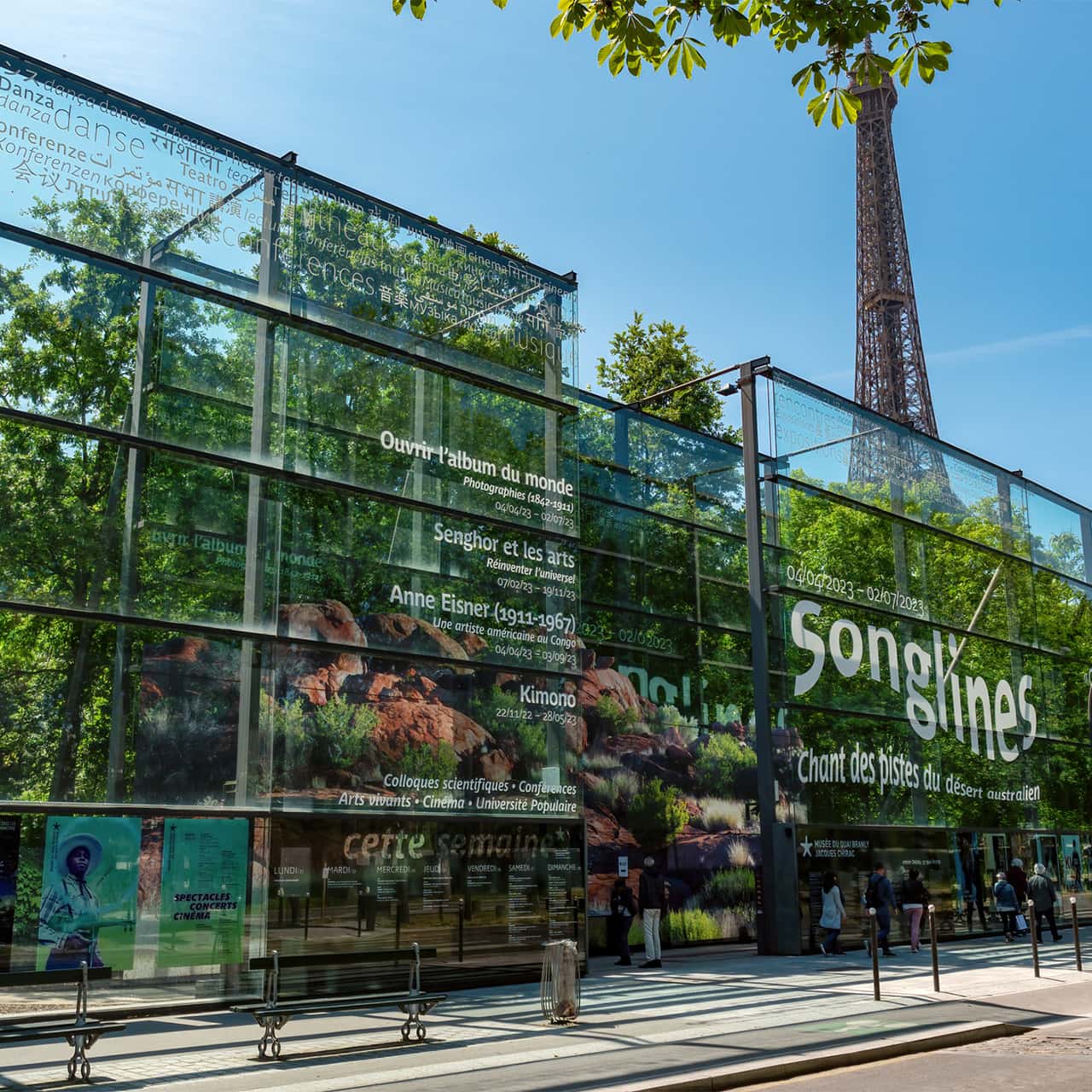
The Quai Branly – Jacques Chirac Museum is one of the most fascinating cultural institutions in Paris. Located along the left bank of the Seine, just steps from the Eiffel Tower, this museum is dedicated to the arts and civilizations of Africa, Asia, Oceania, and the Americas. Inaugurated in 2006 and named after former French President Jacques Chirac, the Quai Branly Museum is distinguished by its bold architecture and the extremely rich cultural heritage it preserves.
Designed by architect Jean Nouvel, the Quai Branly Museum blends seamlessly into the surrounding urban and natural landscape. Its modern structure faces directly onto the Seine and is built on pillars, giving the impression of floating among the trees in the surrounding garden. The most distinctive element of the museum is the vegetation wall, an exterior wall entirely covered with plants, which gives the building an organic and vital appearance.
This fusion of nature and architecture is one of the hallmarks of the museum, which invites visitors to immerse themselves in a unique sensory and cultural experience. The large windows offer striking views both to the interior of the museum and to the exterior, with views of the garden and river.
The museum’s collections
The Musée du Quai Branly houses one of the world’s largest collections of art and artifacts from non-European cultures. With more than 300,000 objects, the museum celebrates the arts and traditions of indigenous peoples and non-Western civilizations, offering an in-depth look at cultures often underrepresented in traditional museums.
Permanent exhibits include African tribal masks, wood and stone carvings from Oceania, pre-Columbian textiles, and ritual tools from Asian cultures.
Each piece on display tells a story, allowing visitors to explore the symbols, myths and beliefs of ancient peoples. The museum is divided into four main geographical areas: Africa, Asia, Oceania and the Americas, offering a true journey around the world without leaving Paris.
The Quai Branly Museum is not only an exhibition venue, but also a center for the study and appreciation of non-European cultures. In fact, temporary exhibitions, lectures, concerts, and screenings are regularly organized within it, exploring topics related to anthropology, art history, and cultural diversity.
The museum promotes awareness and understanding of distant cultures, uniting past and present in a space of dialogue and sharing.
The Quai Branly Museum from the Seine
During a cruise on the Seine, the Quai Branly Museum looks like a hidden gem along the river, with its contemporary architecture standing out among the city’s more traditional buildings. The view from the river allows you to fully appreciate the museum’s innovative design, with its balance of modern lines and the lush vegetation that surrounds it.
Viewing the Quai Branly Museum from the Seine is a fascinating experience, allowing you to grasp the encounter between modernity and the global cultural heritage that the museum represents. Far from the mass tourism that often surrounds well-known monuments, viewing the museum from the river offers a moment to reflect on the diversity and beauty of the world’s cultures. Its architecture, with its garden extending to the river bank, creates a striking contrast to the classical forms of other Parisian buildings.
From the cruise, the plant wall appears almost like a living work of art, changing with the seasons, offering a constantly evolving symphony of colors. The museum’s strategic location near the Eiffel Tower makes its profile easily recognizable on the way, and offers food for thought on how Paris is a city in constant dialogue between the past and the future, between tradition and modernity.
Hôtel des Invalides
Napoleon’s Mausoleum
ID 103447941 @ Manjik | Dreamstime.com
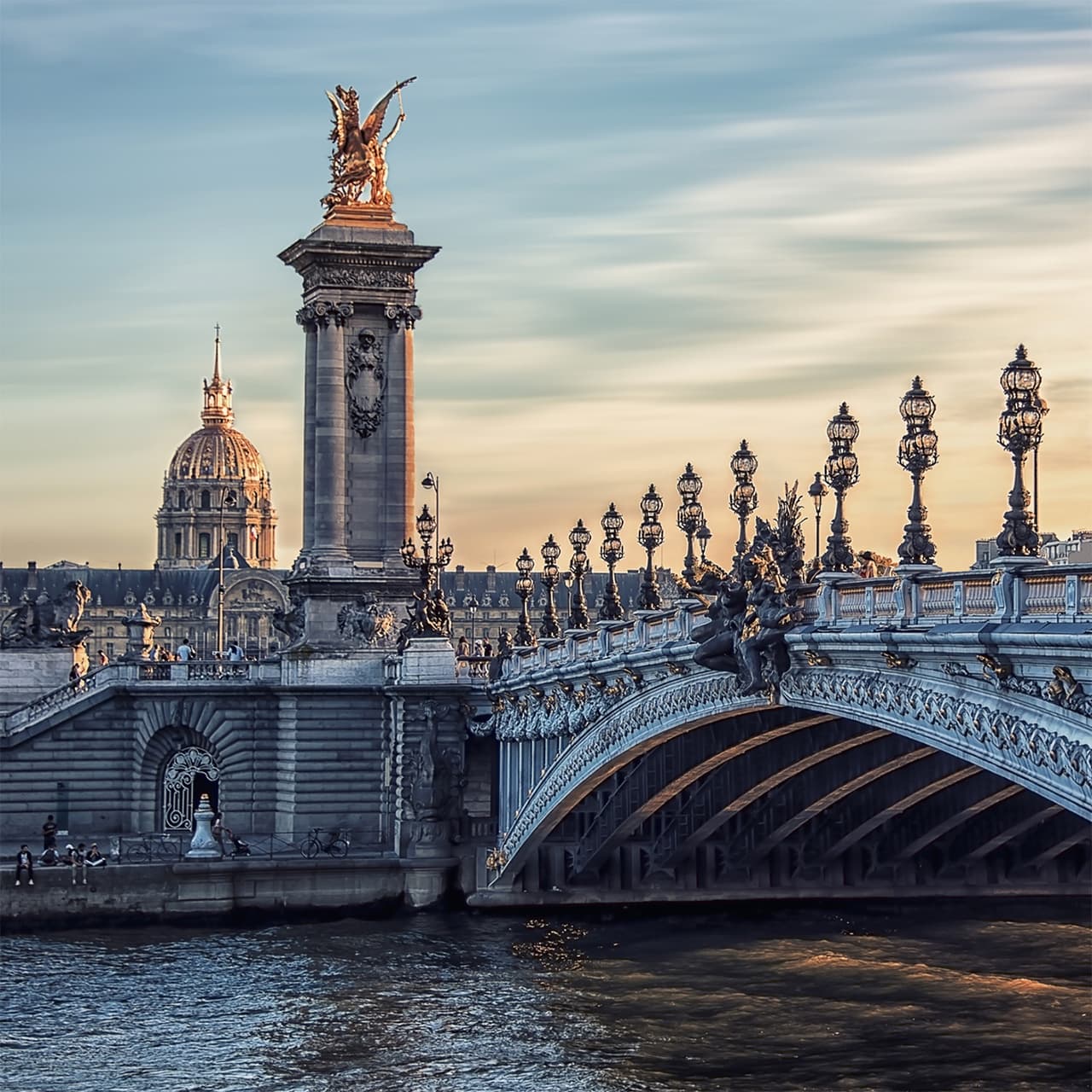
The Hôtel des Invalides is one of the most majestic and significant monuments in Paris, a place that encompasses centuries of French military history and houses the famous mausoleum of Napoleon Bonaparte. Located on the left bank of the Seine, this imposing architectural complex with its distinctive golden dome dominates the city skyline and is an unmissable stop during a cruise along the river.
The Hôtel des Invalides was built at the behest of King Louis XIV in 1670 to provide shelter for war veterans who had served France. Before its construction, soldiers who were wounded or too old to fight were often forced to beg in the streets. Louis XIV wanted to create a place that honored the sacrifices of his soldiers by providing them with a dignified residence and adequate services.
The building was designed by architect Libéral Bruant and was completed in 1676. Later, under the leadership of Jules Hardouin-Mansart, the famous Église du Dôme was added, completed in 1708, which today represents one of the most spectacular examples of Baroque architecture in Paris. The church was later converted into the mausoleum of Napoleon Bonaparte, who was buried here in 1840, when his remains were brought back to France from the island of St. Helena.
The Hôtel des Invalides is a vast complex that covers more than 13 hectares and includes courtyards, gardens and several buildings dedicated to commemorating French military glory. The Dôme des Invalides, with its unmistakable gilded roof towering 101 meters high, is visible from many points in the city and is the symbolic heart of the complex.
The gilded dome is covered with more than 12 kilos of gold and has been restored several times to maintain its luster. Its imposing and ornate architecture represents the triumph and military grandeur of France, a symbol visible from many parts of Paris, including the Seine.
Napoleon’s Mausoleum
One of the main attractions of theHôtel des Invalides is undoubtedly the mausoleum of Napoleon Bonaparte, located inside the Église du Dôme. After his death in exile on St. Helena in 1821, Napoleon was buried on the island, but in 1840 King Louis Philippe had his remains brought back to France in a solemn ceremony. Since then, Napoleon has rested under the grand dôme, in a sumptuous red quartzite sarcophagus surrounded by a series of statues representing his victories.
The mausoleum is one of the most visited attractions in the complex and represents a pivotal moment in French history. The crypt is decorated with precious marbles and frescoes extolling the emperor’s achievements, creating a solemn setting charged with symbolism.
The military museums
In addition to Napoleon’s mausoleum, the Hôtel des Invalides also houses a number of museums devoted to France’s military history. The most important is the Musée de l’Armée, one of the largest military history museums in the world. Its collections range from medieval weapons and armor to include artifacts from the world wars and personal items of Napoleon himself.
The museum is divided into several thematic sections, including the Galerie des Plans-Reliefs, which houses scale models of French fortifications, and the Hall of the Two World Wars, which offers an overview of French military history from 1871 to 1945. These museums make the Hôtel des Invalides not only a place of remembrance but also an educational center for those who want to learn more about the country’s military history.
The Hôtel des Invalides from the Seine
During a cruise on the Seine, the Hôtel des Invalides stands out for its privileged location and architectural splendor. The Dôme des Invalides, with its brilliant golden dome, is visible from afar, and is one of the highlights of the ride. The cruise allows you to appreciate the imposing structure and grasp the symbolism of the place, away from the crowds and in a peaceful atmosphere.
Viewing the Hôtel des Invalides from the river offers a unique perspective on its architecture. The complex stretches elegantly along the left bank, and the passage from the Pont Alexandre III offers a privileged vantage point on this masterpiece of history and art. At night, the golden dome is illuminated, creating a play of light that reflects off the waters of the Seine, making the scene even more striking.
The Hôtel des Invalides is more than just a monument: it is a place that tells the story of France through its wars, heroes and conquests. It is a symbol of French military glory, but also a place of memory and reflection. Admiring it during a cruise on the Seine allows you to grasp its majesty without hurry, as you immerse yourself in the history of one of France’s most important figures, Napoleon Bonaparte.
Visiting the Hôtel des Invalides means not only exploring its impressive architecture, but also discovering its museum collections and reflecting on France‘s complex and fascinating history. An essential stop for lovers of history and architecture, to be fully experienced from both land and river.
Seine River Cruise Tickets
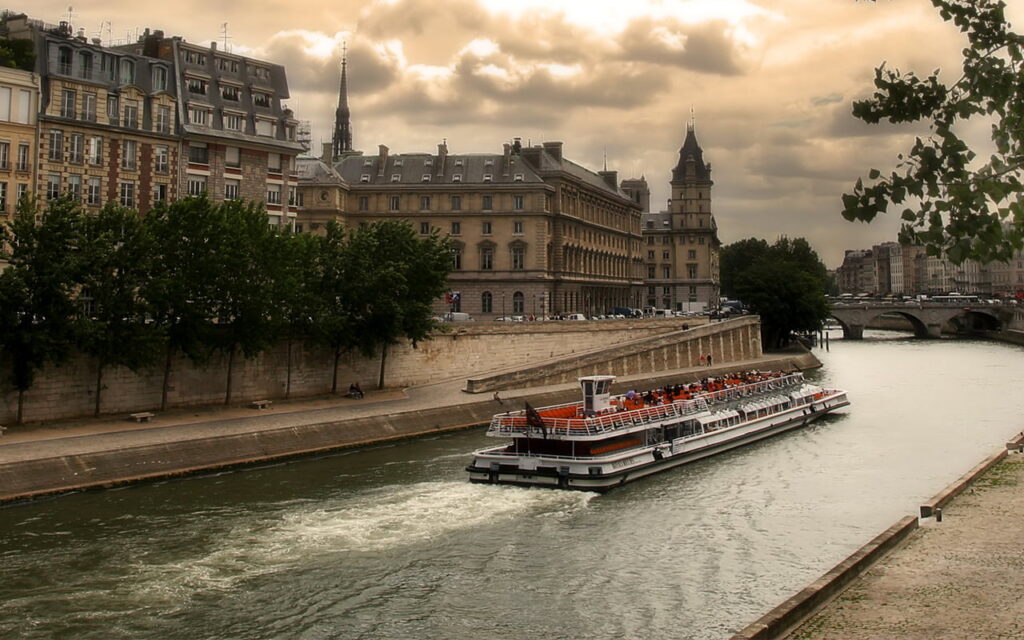
Discover Paris from a new perspective with a classic cruise on the Seine. Tour among the most iconic monuments from the comfort of the boat.
You can cancel up to 24 hours before your visit
Pont Alexandre III
The most elegant bridge in Paris
ID 46674832 @ Marcin Jucha | Dreamstime.com
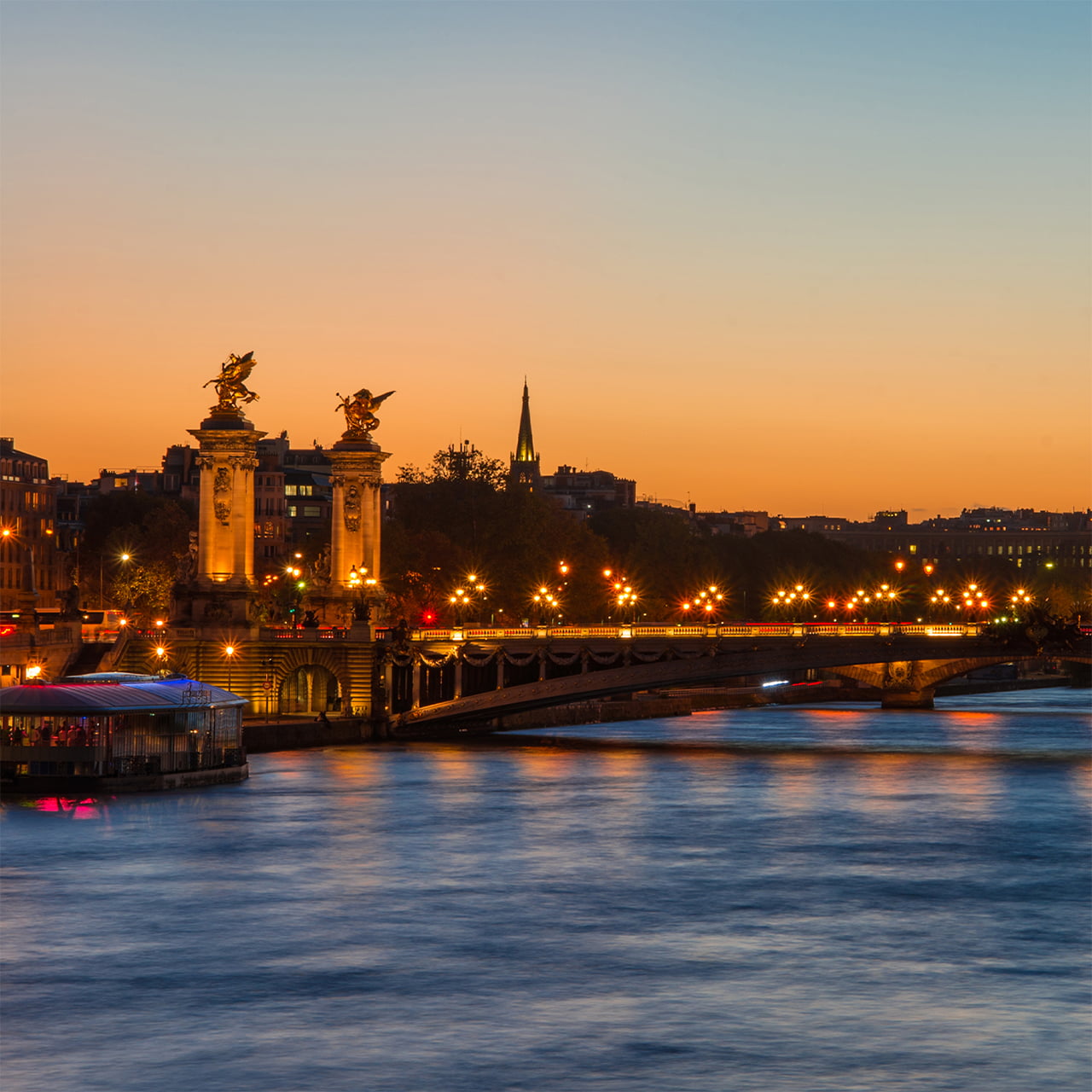
The Pont Alexandre III is considered the most elegant and ornate bridge in Paris, a masterpiece of engineering and architecture that spans the Seine, connecting the Invalides with the Grand Palais and Petit Palais. Built for the 1900 World’s Fair, it is a symbol of the strong link between France and Russia and is one of the most spectacular examples of the Beaux-Arts style in the French capital.
The Pont Alexandre III was built to commemorate the alliance between France and Russia, enshrined in the agreement between Tsar Alexander III and French President Sadi Carnot. The bridge was named after Alexander III himself, in honor of the Russian ruler. The foundation stone was laid in 1896 by Alexander’s son Nicolas II, and the bridge was completed in time for the opening of the 1900World’s Fair, an event celebrating France’s industrial and cultural achievements.
The Pont Alexandre III is a perfect example of advanced engineering for the time, with a single span spanning 107 meters without any central supports, a true technological marvel in the late 19th century. The bridge is built in
iron and adorned with a series of spectacular decorations that make it one of the most admired sights by visitors to Paris.
The architecture and decorations
The Pont Alexandre III is famous for its rich decorations, which include gilded statues, Art Nouveau-style lampposts and elaborate sculptures. At the ends of the bridge are four imposing pillars, each 17 meters high, topped by gilded statues of winged pegasuses, symbols of art and science, representing the triumph of culture and civilization. These statues are the works of some of the best French sculptors of the time, including Emmanuel Frémiet and Georges Récipon.
Gilded bronze details, such as the nymphs of the Seine and the nymphs of the Neva River, symbolize the link between Paris and St. Petersburg, and reinforce the idea of brotherhood between France and Russia. The combination of monumental architecture, artistic decoration and advanced technology makes the Pont Alexandre III a masterpiece of the Belle Époque.
The Pont Alexandre III from the Seine
During a cruise on the Seine, the Pont Alexandre III is one of the most spectacular moments of the journey. Admiring the bridge from the river allows you to fully appreciate its majesty and decorations, especially the golden statues that glow in the sunlight or under the night lighting. As you pass under the bridge, you will notice the intricate details of the lampposts and sculptures, elements that can be missed when walking across it.
The Pont Alexandre III also offers exceptional panoramic views of the Eiffel Tower, the Invalides and the Grand Palais, making it one of the most photographed and admired bridges in Paris. At night, the bridge is illuminated by gleaming Art Nouveau street lamps, creating a magical and romantic atmosphere, ideal for an evening cruise on the Seine.
The Pont Alexandre III is not only a masterpiece of engineering and architecture, but also a symbol of the historic alliance between France and Russia and an emblematic example of the Beaux-Arts style. Admiring this bridge during a cruise on the Seine allows you to appreciate its every detail in a relaxed, crowd-free atmosphere.
The Pont Alexandre III represents a perfect fusion of art, history, and technology, and one of the most recognizable structures in Paris.
Its rich decoration, historical significance, and strategic location along the Seine make it a must-see for anyone visiting the city. The night view of the bridge, when illuminated by its twinkling lights, is an experience that remains etched in every visitor’s memory.
Grand Palais and Petit Palais
The legacy of the World’s Fair
ID 168445267 @ Mykhailo Pavlov | Dreamstime.com
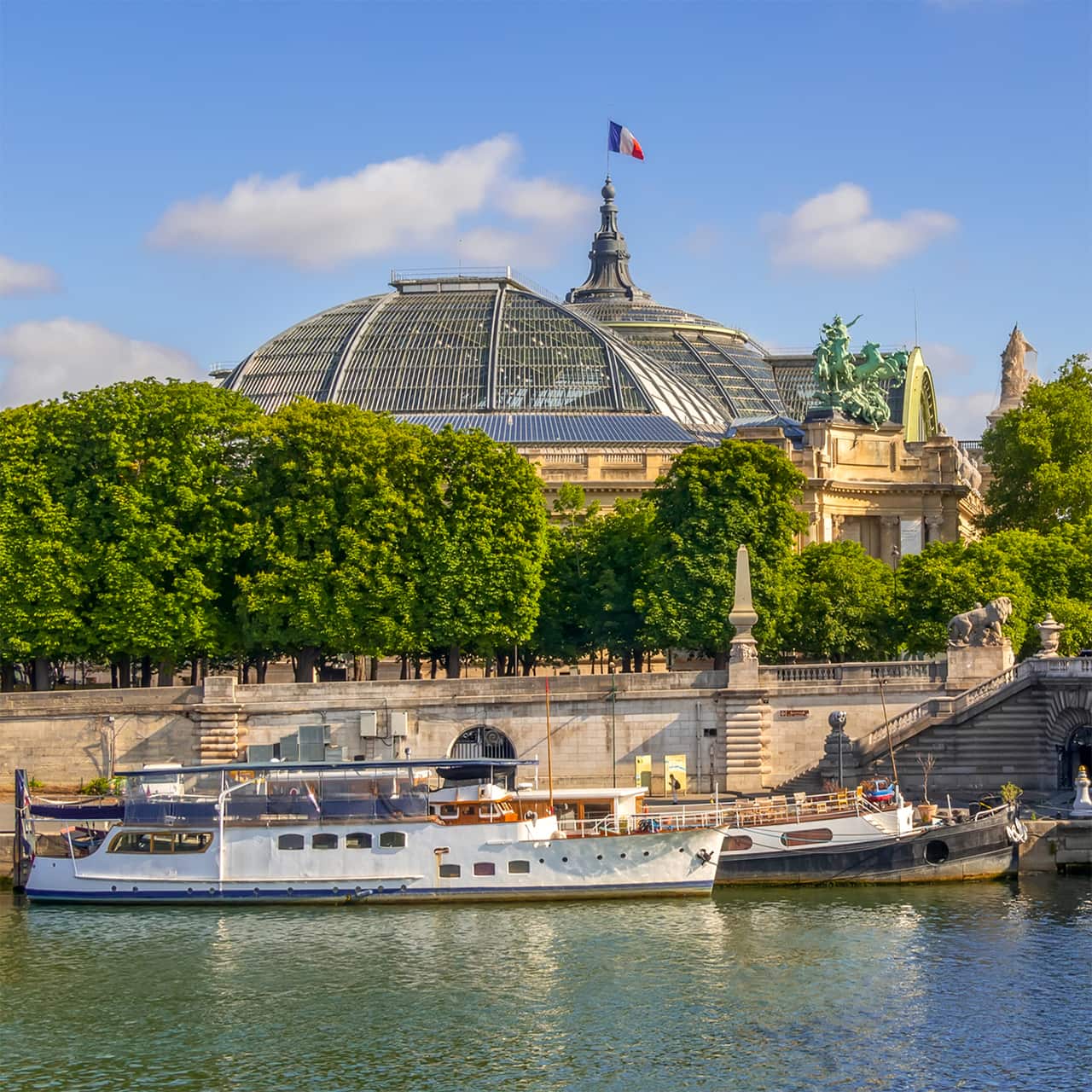
The Grand Palais and Petit Palais are two magnificent buildings located along the Champs-Élysées in Paris and represent the pinnacle ofBelle Époque architecture. Built for the Universal Exposition of 1900, they are now considered cultural and artistic icons of the city. Both palaces were built to celebrate the progress and creativity of France at the dawn of the 20th century, and their architectural beauty makes them highlights for those visiting the city, especially during a cruise on the Seine.
The Grand Palais and Petit Palais were built for the Universal Exhibition of 1900, an event that marked France‘s entry into the 20th century and celebrated technological and artistic innovation. The Grand Palais was conceived as a temple to the fine arts and was designed by a team of architects, including Henri Deglane, Albert Louvet, Albert Thomas, and Charles Girault, the latter also responsible for the design of the Petit Palais. These buildings, with their impressive architecture and elaborate decorations, were to represent the greatness of French culture.
The Grand Palais is famous for its iron and glass structure, making it one of the largest glass buildings in the world, with a total area of more than 77,000 square meters.
The Petit Palais, on the other hand, was designed as a fine arts museum, and features a curved facade and an inner courtyard with a garden.
Architecture and design of the Grand Palais and Petit Palais
The Grand Palais is a spectacular example of Beaux-Arts architecture and is distinguished by its gigantic glass roof and iron dome, 45 meters high, which flood the interior with natural light. This monumental roof is one of the largest ever built in Europe and remains one of the main architectural features of Paris.
The interior consists of a vast central nave (the Nef), used for exhibitions, fairs, and major events. The combination of glass, iron, and stone creates an effect of lightness and modernity that enchants anyone who enters the building.
The Grand Palais also houses the Palais de la Découverte, a science museum open to the public, which is an integral part of the complex. Exterior decorations include a series of impressive and detailed sculptures, such as the gilded quadriges (sculptures of horse-drawn chariots) on the facades, created by artists such as Georges Récipon.
Opposite the Grand Palais, the Petit Palais is a more intimate but equally extraordinary structure dedicated to the fine arts. Its facade, with an imposing arched entrance decorated with Corinthian columns and intricate sculptures, leads to an elegant and refined interior. One of the distinctive features of the Petit Palais is its inner courtyard, which houses a lovely garden with fountains and mosaics. The design creates a contrast between the grandeur of the exterior architecture and the tranquility and intimacy of the interior spaces.
The Petit Palais now houses the Musée des Beaux-Arts de Paris, which includes works of art ranging from ancient times to the 19th century, with paintings by famous artists such as Monet, Cézanne, Courbet, and Delacroix.
Thanks to recent restoration, the Petit Palais has been renovated to combine modernity with the spirit of the 1900s.
The Grand Palais and the Petit Palais from the Seine
During a cruise on the Seine, the Grand Palais and Petit Palais offer spectacular views, particularly when viewing them from the Pont Alexandre III, which connects the two buildings to the opposite bank of the river. From the river, you can admire the Grand Palais’s large glass roof, which reflects natural light beautifully, and the Petit Palais‘s ornate facade, which stands out for its elegance and architectural harmony.
The evening view is particularly striking, with the Grand Palais illuminated and its dome shining under the lights of Paris. The contrast between the two buildings, the majestic Grand Palais and the refined Petit Palais, is a perfect example of the grandeur of the Belle Époque and a memorable moment of the cruise.
Place de la Concorde
A historic and iconic square in Paris
ID 112115449 @ Ludoriri | Dreamstime.com
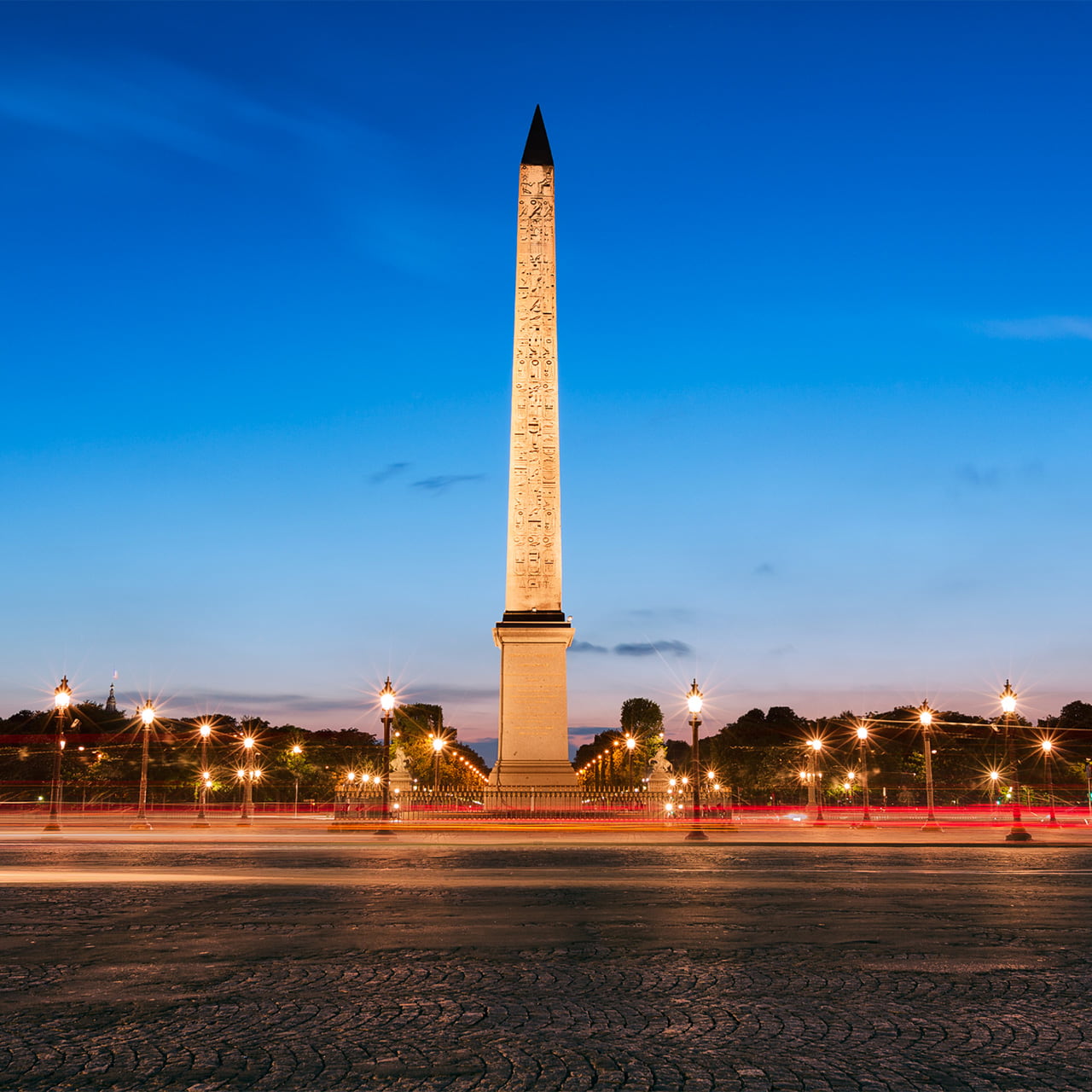
The Place de la Concorde is one of the largest and most famous squares in Paris, located between the Champs-Élysées and the Tuileries Gardens. Covering 84,000 square meters, it is a central point in the history and geography of the French capital, as well as a place rich in symbolism and historical events. Place de la Concorde is famous for its imposing Egyptian obelisk, its two monumental fountains, and its importance in the French Revolution.
Originally named Place Louis XV in honor of King Louis XV, the square was designed in 1755 by architect Ange-Jacques Gabriel. An equestrian statue of Louis XV stood in the center of the square, but the history of Place de la Concorde changed dramatically during the French Revolution. The square became infamous as Place de la Révolution, the place where the guillotine was installed. Between 1793 and 1794, many famous people were executed here, including Louis XVI, Queen Marie Antoinette, and other leading figures of the French monarchy and aristocracy.
In 1795, the square was renamed Place de la Concorde to represent the new peace and national unity. Today, this name stands as a symbol of reconciliation and stability in France, making the Place de la Concorde not only a historic place, but also an emblem of national harmony.
The Obelisk of Luxor
At the center of the Place de la Concorde stands the famous Luxor Obelisk, a granite monolith 23 meters tall and weighing more than 227 tons. This Egyptian obelisk dates back more than 3,000 years and was originally located at the entrance to the Luxor Temple in Egypt. It was donated to France by the vice-king of Egypt, Méhémet Ali, in 1831 as a symbol of friendship between the two countries.
The Obelisk of Luxor was erected in the center of the square in 1836 by order of Louis Philippe and is one of the most outstanding examples of Egyptian antiquity in Europe. The obelisk’s base is decorated with engravings describing the transportation of the obelisk from Egypt to France, and its hieroglyphics recount the exploits of Pharaoh Ramses II. During a cruise on the Seine, the view of the Luxor Obelisk in the center of the Place de la Concorde is spectacular, especially when the monolith glows in the Parisian sun or evening lights.
The monumental fountains
The Place de la Concorde is adorned with two magnificent monumental fountains: the Fountain of the Seas and the Fountain of Rivers. These fountains were added during the reign of Louis Philippe and designed by architect Jacques Ignace Hittorff between 1836 and 1840.
The Fountain of the Seas celebrates the rivers and seas surrounding France, while the Fountain of Rivers represents the main French rivers, such as the Seine and the Rhone.
The two fountains are decorated with gilded statues, tritons, and mythological figures, and their elegance immediately captures visitors’ attention. Admiring them during a cruise on the Seine is a magical experience, as the fountains create a romantic and regal atmosphere, especially at night when they are illuminated.
The Place de la Concorde from the Seine
Place de la Concorde is one of the most iconic spots visible during a cruise on the Seine. The view of the square from the river allows one to appreciate the Luxor Obelisk, the monumental fountains, and the strategic location of the square, which connects the Champs-Élysées with the Tuileries Gardens. The walkway along the Seine offers a unique perspective on the Place de la Concorde, highlighting its grandeur and central role in the history of Paris.
At night, the entire square is illuminated, and the fountains and obelisk glow, creating a unique spectacle for anyone who is cruising along the river. The Place de la Concorde’s location near other historical monuments, such as the Louvre and the National Assembly, makes it one of the most photographed and admired attractions in the capital.
National Assembly
The heart of French democracy
ID 182044289 @ OlenaSign | Dreamstime.com
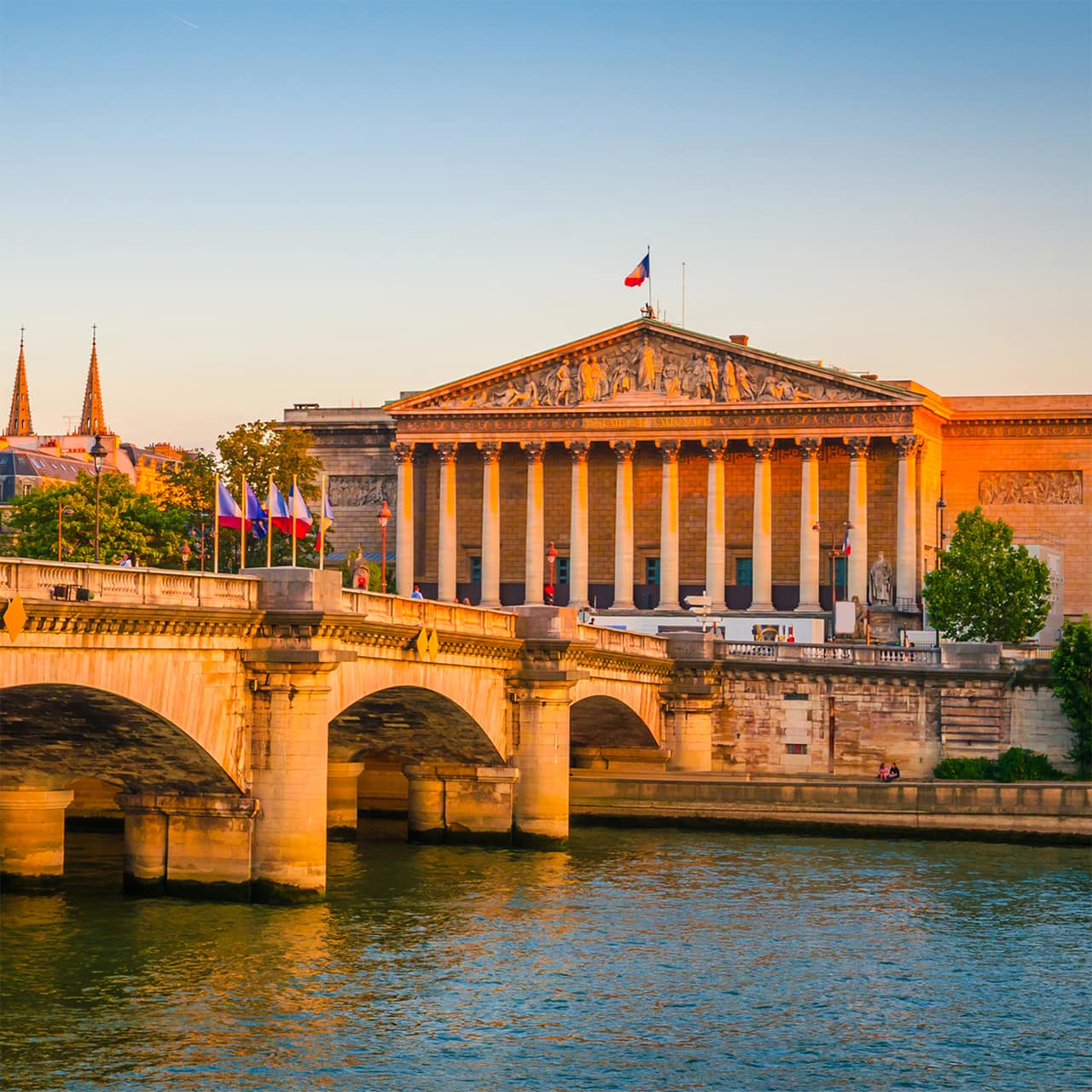
The National Assembly is one of the most important buildings in Paris and represents the heart of French democracy. Located along the left bank of the Seine opposite the Place de la Concorde, the National Assembly is housed in the majestic Palais Bourbon, a historic building that is the symbol of France‘s legislative power. Its central location and neoclassical architecture make it an imposing landmark, also visible during a cruise on the Seine.
The Palais Bourbon, seat of the National Assembly, was built on the initiative of Louise Frances de Bourbon, the natural daughter of Louis XIV and the Marquise de Montespan, who commissioned the construction in 1722. Initially planned as a private residence, the palace passed to the royal family and was later transformed into the seat of legislative power after the French Revolution. Since 1795, the Palais Bourbon has housed the National Assembly, the lower house of the French Parliament, one of the main organs of France‘s democratic system.
The National Assembly has witnessed key moments in France‘s history, including the passage of the most important laws and reforms. The building has undergone several modifications and expansions over the centuries to adapt to the needs of the French parliament and to represent the nation’s change and modernity.
The architecture of the Palais Bourbon
The Palais Bourbon is a masterpiece of neoclassical architecture. The main facade, designed by architect Bernard Poyet in 1806, is inspired by the Pantheon in Rome and features a majestic Corinthian col onnade with twelve columns. This colonnade dominates the Quai d’Orsay and creates an imposing visual image representing the solidity and authority of the French Parliament.
Inside, the National Assembly boasts rich and refined decorations, with frescoes and artwork celebrating the history and values of the French Republic. One of the building’s focal points is the Hemicycle, the semicircular chamber where deputies gather to debate and vote on laws. The Hemicycle is decorated with busts and paintings representing iconic figures from France’s history, and its architectural lines are designed to encourage political debate and reflection.
The political and symbolic role of the National Assembly
The National Assembly plays a fundamental role in the French political system. It is the lower house of Parliament and has the power to legislate, debate and vote on laws. Members of the National Assembly are elected every five years, and this body directly represents the French people, ensuring democratic participation in the nation’s political life.
The Palais Bourbon is also a symbol of freedom and democracy, as it reflects the principles of equality and fraternity that underlie the French Republic.
The National Assembly buildings are often the site of grand ceremonies and solemn speeches, and their political significance is also visible in their impressive architectural appearance.
The National Assembly from the Seine
During a cruise on the Seine, the National Assembly is easily recognized by its central location and its imposing neoclassical facade on the Quai d’Orsay. The perspective from the river offers a unique view of the Palais Bourbon, with its colonnade silhouetted against the Parisian sky and representing the power and stability of France. Admiring the building from the river allows one to grasp the balance and symmetry of its architecture, which reflects the values of the nation.
At night, the façade of the National Assembly is illuminated, creating a spectacular visual effect that highlights its symbolic importance in the heart of Paris. The view of the Place de la Concorde across the river completes this picture, making a cruise on the Seine a perfect time to appreciate the historical and architectural significance of the National Assembly.
Seine River Cruise Tickets
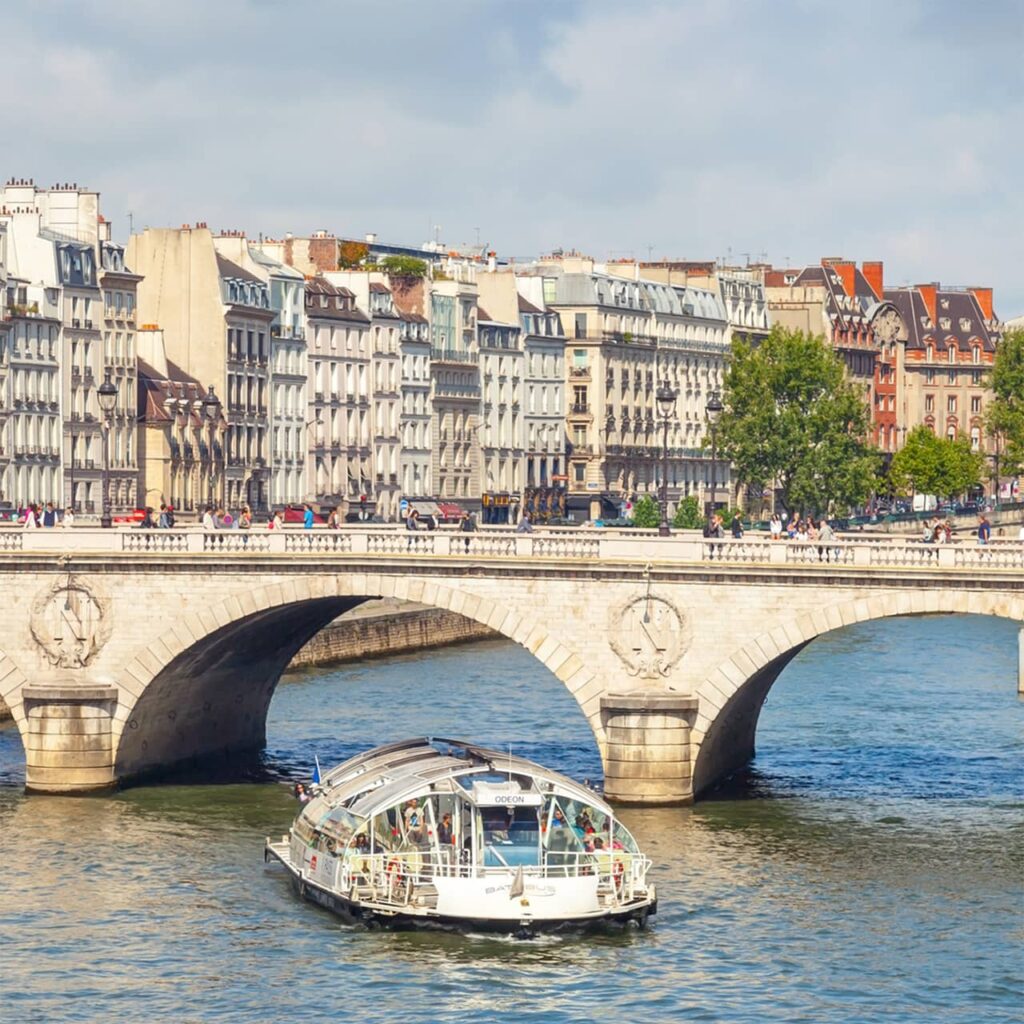
Perfect for those with limited time: a scenic cruise that takes you to the heart of Paris, including history, art and beauty.
You can cancel up to 24 hours before your visit
Musée d’Orsay
The temple of Impressionism
ID 132140128 @ Fabrizio Robba | Dreamstime.com
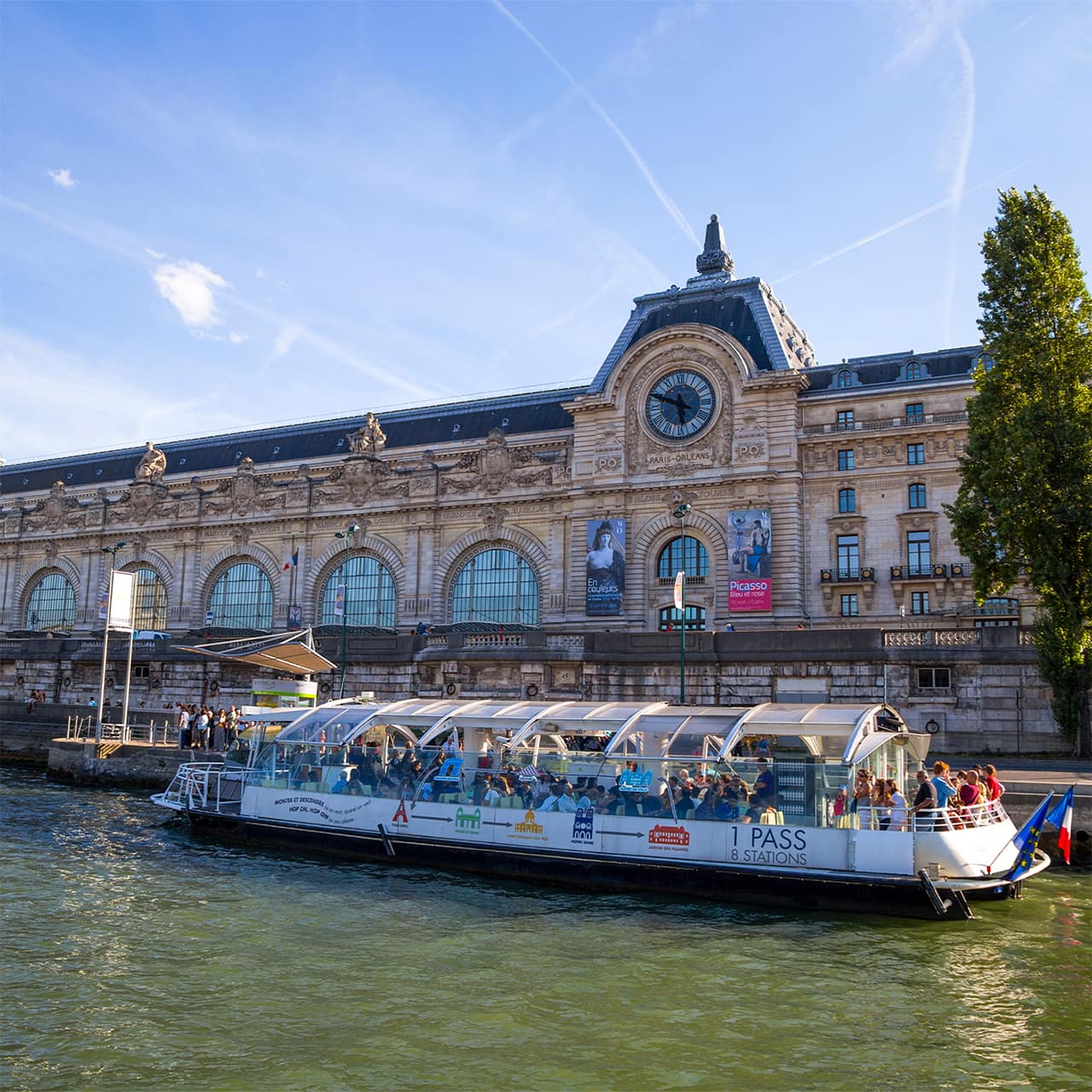
The Musée d’Orsay is one of the most celebrated museums in Paris and houses the world’s largest collection of Impressionist and Post-Impressionist art. Located on the left bank of the Seine, opposite the Louvre Museum, the Musée d’Orsay is known both for its extraordinary works of art and for its majestic architectural structure, a former train station converted into a museum. Its combination of history, art, and architecture makes it a must-see stop during a cruise on the Seine.
The building that now houses the Musée d’Orsay was originally built as a train station, the Gare d’Orsay, for the Universal Exhibition of 1900. Designed by architect Victor Laloux, the station was intended to serve rail traffic on France’s southwest network. With its monumental stone facade and imposing clock, the Gare d’Orsay quickly became a symbol of the railway architecture of the time.
In later years, the station became obsolete for more modern trains and, after being used for various purposes, was closed for good in the 1970s. In 1977, it was decided to turn the Gare d’Orsay into a museum, devoted mainly to 19th-century art. The Musée d’Orsay officially opened its doors to the public in 1986 and immediately became a major institution, attracting visitors from all over the world.
The collection of the Musée d’Orsay
The Musée d’Orsay is renowned for its outstanding collection of Impressionist and Post-Impressionist works, which includes masterpieces by artists such as Monet, Degas, Renoir, Cézanne, Van Gogh, and Gauguin. These works, created between 1848 and 1914, represent one of the most innovative phases in art history, characterized by a revolution in color, light and the representation of reality.
Among the most famous works on display are Renoir’s Dance at the Moulin de la Galette, Monet’s Poppy Field, and Van Gogh’s Self-Portrait. The museum also houses important paintings by Courbet, such as L’origine du monde, and sculptures by artists such as Rodin. These works offer a comprehensive overview of modern art, from the early experiments of Impressionism to Symbolist and Art Nouveau art.
The architecture and interior design
One of the most fascinating aspects of the Musée d’Orsay is its unique architecture. The transformation from train station to art museum has kept the main structure intact, with the large central nave topped by a massive glass roof that floods the interior with natural light. This vaulted roof creates a light and airy environment that makes for a particularly pleasant and immersive visitor experience.
The museum is arranged on several levels, with galleries displaying works in chronological order, allowing visitors to follow the evolution of modern art. One of the most iconic elements is the large station clock, visible from the upper gallery, which has been preserved and offers a panoramic view of the city and the Seine. This fusion of history and modernity makes the Musée d’Orsay a unique place in the Paris museum scene.
The Orsay Museum from the Seine
During a cruise on the Seine, the Musée d’Orsay is easily recognized by its imposing neoclassical facade and large clock overlooking the river. Viewing the Musée d’Orsay from the river offers a unique perspective on the structure, allowing you to appreciate its central location and architectural magnificence. Admiring the museum from the river, especially during the evening hours when the building is illuminated, is a magical experience that enriches the cruise.
The Musée d’Orsay is in a prime location along the cruise route, between the Louvre and the National Assembly, and offers a spectacular view that embodies the combination of history, art, and architectural innovation.
The Louvre
The most famous museum in the world
ID 23588997 @ Maria Vazquez | Dreamstime.com
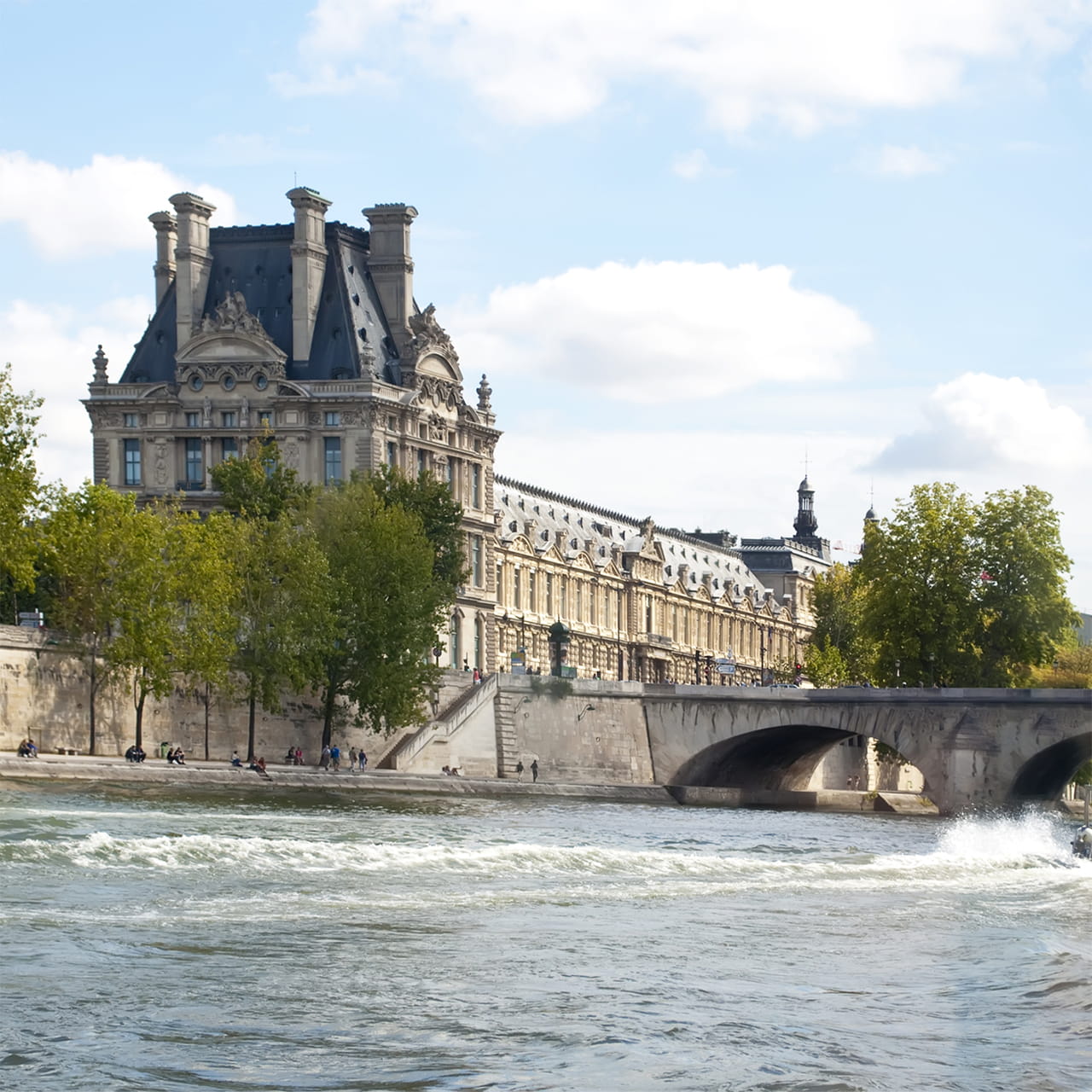
The Louvre Museum is the world’s largest and most visited art museum and one of the most iconic symbols of Paris and France.
Located in the heart of the city on the right bank of the Seine, the Louvre is famous not only for its priceless collection of artworks, but also for its unique architectural structure, which combines the old royal palace with the modern glass pyramid. Admiring the Louvre during a cruise on the Seine is a unique experience that allows you to appreciate its majesty and historical significance.
The Louvre has an ancient and complex history dating back to the 12th century, when it was built as a fortress by King Philip Augustus to protect the city from invasion. Over the centuries, the Louvre was transformed from a fortified castle to a royal residence and then to a museum. It was in 1793, during the French Revolution, that the Louvre officially opened its doors as a public museum, becoming a symbol of France’s cultural heritage.
During the reign of Francis I in the 16th century, the Louvre began to accumulate a collection of artworks, which included some of the earliest acquisitions, such as Leonardo da Vinci‘s Mona Lisa. Over the following centuries, French rulers, particularly Louis XIV, helped enrich the Louvre’s collections, gradually transforming it into one of Europe’s most important cultural centers.
The Louvre’s collection
The Louvre Museum houses a vast and diverse collection, with more than 35,000 works spread over 73,000 square meters. The collection covers a wide range of historical periods and civilizations, from Mesopotamia to Ancient Egypt, from Ancient Greece and Rome to the 19th century. Some of the world’s most famous pieces are displayed in its halls, such as Leonardo da Vinci’s Mona Lisa, the Venus de Milo, and the Nike of Samothrace.
The Louvre is divided into several thematic areas, including Oriental Antiquities, Egyptian Antiquities, Greek, Etruscan and Roman Antiquities, Islamic Art, Sculpture, Decorative Arts and European Painting. Each section offers a complete immersion in a specific part of human history and culture, making the Louvre a must-see destination for art and history lovers.
The architecture of the Louvre and the Glass Pyramid
One of the most distinctive aspects of the Louvre is its architecture. The museum is located in what was once the Palais du Louvre, a former royal palace. However, the most recognizable element of the Louvre today is its modern glass pyramid, inaugurated in 1989 and designed by architect Ieoh Ming Pei. This pyramid serves as the main entrance to the museum and is a fascinating contrast between ancient and modern, blending seamlessly into the Louvre‘s courtyard, known as the Cour Napoléon.
The glass pyramid is 21.6 meters high and composed of 673 sheets of glass, allowing natural light to filter inside, creating a bright and welcoming atmosphere for visitors. The pyramid has become a global icon, representing the Louvre around the world and attracting millions of visitors each year. At night, the illuminated pyramid creates a spectacular effect, visible even from the Seine River during a cruise.
The Louvre from the Seine
During a cruise on the Seine River, the Louvre Museum offers one of the most impressive views. The view of the Palais du Louvre from the Seine allows you to admire its Renaissance facade, which stretches along the river for hundreds of meters and testifies to the architectural grandeur of the former royal residence. The cruise offers a unique perspective on the Louvre, highlighting both its historic structure and the modern glass pyramid at the center of the Cour Napoléon.
This contrast between past and present, between the historic facade and the glass pyramid, makes the Louvre one of the most fascinating attractions visible from the river. At night, the museum and the illuminated pyramid create a striking and romantic scene, making the passage along the Louvre one of the most memorable moments of the Seine River cruise.
Pont Neuf
The oldest bridge in Paris
ID 80784177 @ Leonid Andronov | Dreamstime.com
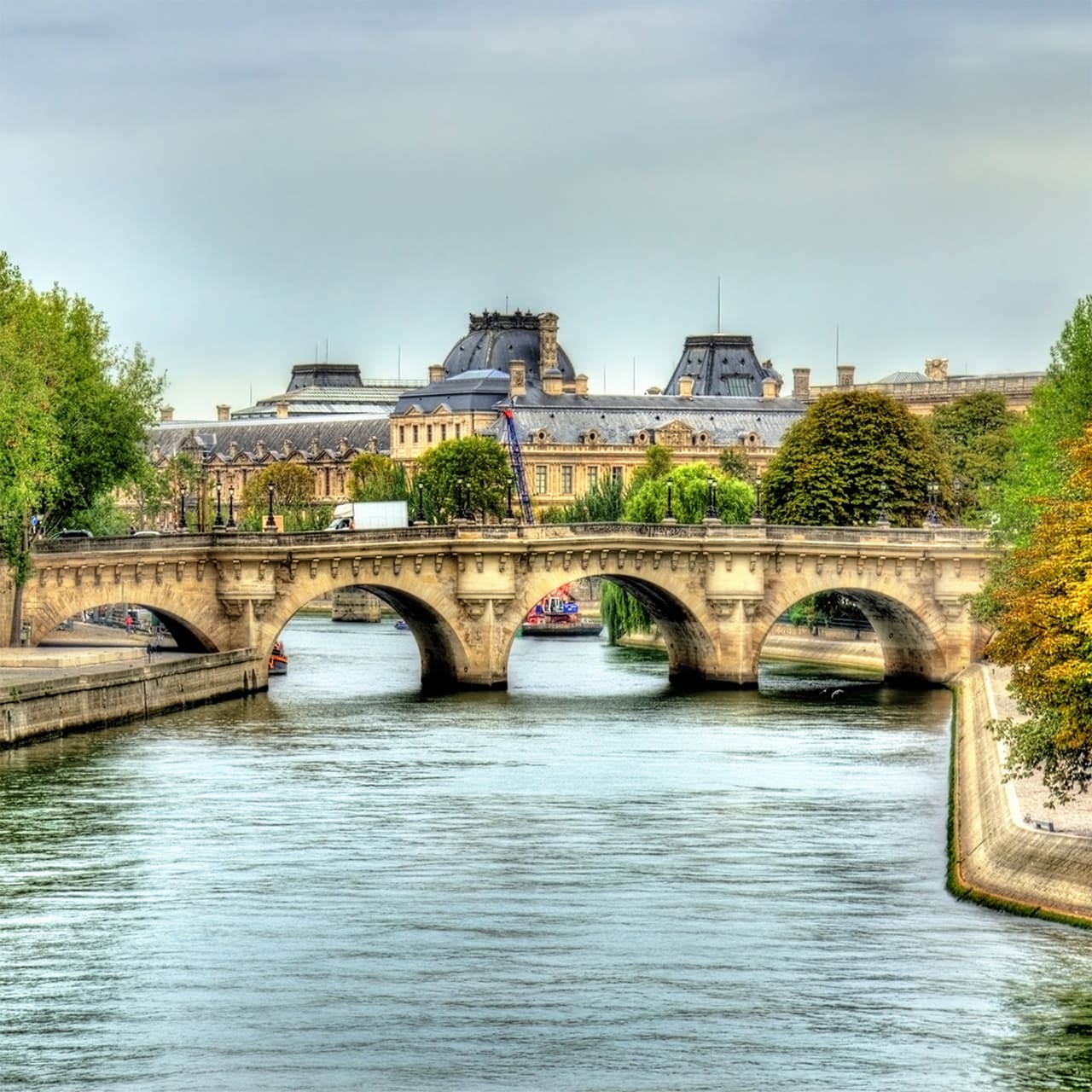
The Pont Neuf is the oldest bridge and one of the most iconic in Paris. Despite its name, which means “New Bridge,” the Pont Neuf was built in the late 16th century and is now one of the French capital’s most famous historical monuments. It spans the Seine, connecting the two banks across the Île de la Cité, the island that houses the famous Notre-Dame Cathedral. This bridge represents a key piece of Paris’ history and is one of the most popular attractions for visitors on a cruise on the Seine.
Construction of the Pont Neuf began in 1578 under the reign of Henry III and was completed in 1607 under Henry IV. This bridge marked a turning point in urban architecture in Paris: it was the first bridge in the city to be built without buildings on top, allowing an unobstructed view of the Seine and providing space for pedestrians to stroll. Henry IV, one of France‘s most beloved kings, also had an equestrian statue of him erected in the center of the bridge on the Île de la Cité. This statue, destroyed during the French Revolution and then rebuilt in 1818, is now a symbol of the bridge and Parisian history.
The Pont Neuf was also innovative in its structure: the bridge included wide sidewalks and numerous niches with statues, where Parisian merchants and artists would settle to sell their wares or display their works. Over the centuries, the Pont Neuf became a meeting point and a place for Parisians to socialize, a role it still maintains today.
The architecture of the Pont Neuf
The Pont Neuf is 232 meters long and 22 meters wide, and is composed of two separate sections connecting the right and left banks of the Seine to the Île de la Cité. Its structure is characterized by twelve arches, each of which features around arch, a distinctive feature of 16th- and 17th-century architecture.
Another distinctive architectural element are the masks, sculptures of grotesque faces that adorn the bridge’s parapets. There are as many as 381 of them and they represent mythological figures and caricatures that give the Pont Neuf a unique and unmistakable appearance. These masks have become one of the most admired features of the bridge and contribute to its historic atmosphere.
The Pont Neuf and the Île de la Cité
The Pont Neuf spans the Île de la Cité, which is the historic heart of Paris and home to some of the city’s most famous monuments, such as Notre-Dame Cathedral and the Conciergerie. At the center of the bridge on Île de la Cité is the equestrian statue of Henri IV, an important landmark for Parisians and visitors alike. Near the statue, there is also the Square du Vert-Galant, a small garden located at the western end of the island, known to be one of the most romantic and peaceful places in Paris.
During a cruise on the Seine, the passage under the Pont Neuf offers a unique perspective of both the bridge itself and the Île de la Cité. This point on the river route allows you to admire its solid and historic structure as well as panoramic views of Notre-Dame and other iconic monuments of Paris.
The Pont Neuf from the Seine
During a cruise on the Seine, the Pont Neuf is one of the most fascinating parts of the route. Viewing the bridge from the river allows you to appreciate its historic architecture, masks, and arrangement of arches. The view from the river highlights its strategic location and its connection to the Île de la Cité, offering a visual experience that highlights its central role in the history and geography of Paris.
At night, the Pont Neuf is illuminated by soft lights that make it a romantic and atmospheric place, perfect to admire during an evening cruise. The lighting enhances the beauty of the masks and the majesty of the arches, turning the Pont Neuf into one of the most photographed spots on the Seine.
Île de la Cité
The historic heart of Paris
ID 99919981 @ Kmiragaya | Dreamstime.com
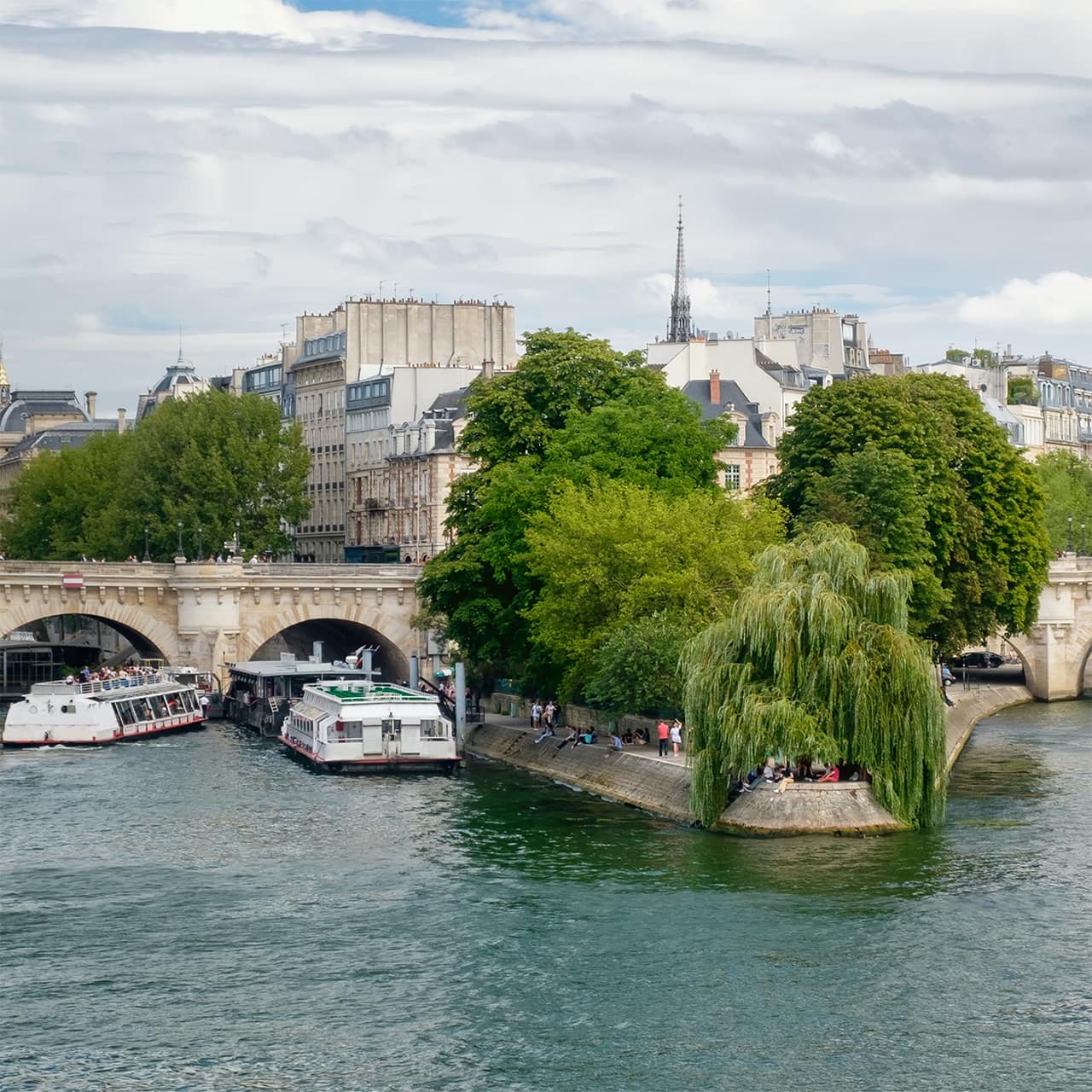
Île de la Cité is considered the historical and geographical heart of Paris, as well as one of the city’s oldest and most symbolic places. Located on the Seine, this small island is the cradle of Parisian civilization, where the city’s history began.
Île de la Cité is home to some of Paris’ most famous and beloved monuments, including the famous Notre-Dame Cathedral, the Sainte-Chapelle and the Conciergerie. A cruise on the Seine offers a unique perspective on this island, allowing visitors to immerse themselves in its thousand-year history.
Île de la Cité has been inhabited since ancient times, having been the center of the first settlement of the Celtic Parisii tribe.
With the Roman conquest in the 1st century BC, the island became the main nucleus of Lutetia, the ancient name for Paris. During the Middle Ages, Île de la Cité became an important religious and political center, housing both Notre-Dame Cathedral and the Palais de la Cité, the seat of royal power.
Over the centuries, Île de la Cité has remained one of the most significant places in Paris, preserving many of its medieval structures and symbolizing the spiritual, political and judicial heart of France. Even today, this island is considered the “kilometer zero” of the French road network, the point from which all distances to Paris are measured.
The monuments of the Île de la Cité
Île de la Cité is home to some of the most important monuments in France and all of Europe. One of the most famous is undoubtedly Notre-Dame Cathedral, a masterpiece ofGothic architecture built starting in 1163 and completed in the 14th century. This cathedral is famous for its towers, rose windows and iconic spires, and is one of the most beloved symbols of Paris. Admiring it from the Seine on a cruise offers a spectacular view of its facade and architectural details.
Another jewel on the island is the Sainte-Chapelle, a chapel built in 1248 at the behest of Louis IX. The Sainte-Chapelle is famous for its extraordinary polychrome stained glass windows that depict biblical scenes and transform the interior of the chapel into a kaleidoscope of colored light. This chapel is a masterpiece of the radiant Gothic style and one of the most fascinating spots on theÎle de la Cité.
Next to the Sainte-Chapelle is the Conciergerie, one of the oldest prisons in Paris and once part of the Palais de la Cité, seat of the kings of France. The Conciergerie is known to have been the place of imprisonment of Queen Marie Antoinette during the French Revolution, before her execution. Today, it is open to the public and is an important record of Paris’s revolutionary history.
The Square du Vert-Galant and the statue of Henri IV
At the western end of the Île de la Cité is the Square du Vert-Galant, a small garden located at the tip of the island, known for its romantic atmosphere and panoramic view of the Seine. This garden is dedicated to Henry IV, the French king known as the “Vert-Galant” for his reputation as an amorous conqueror. Just above the Square du Vert-Galant is the equestrian statue of Henry IV, erected in 1614 and rebuilt after being destroyed during the French Revolution.
The Square du Vert-Galant is a great place for a romantic stroll and offers a spectacular view of the Pont Neuf and the surrounding landscape. During a cruise on the Seine, the tip of the island is an iconic crossing point that allows you to observe the contrast between the calm of the garden and the lively history of the Île de la Cité.
Île de la Cité from the Seine
During a cruise on the Seine, Île de la Cité is one of the most fascinating points on the route. The view of Notre-Dame Cathedral, the Sainte-Chapelle, and the Conciergerie from the water offers a complete immersion in the history of Paris. The Île de la Cité represents the beating heart of the city, a place where spirituality, power and culture are intertwined, and the passage along the river allows you to admire these monuments from a unique perspective.
At night, the island is illuminated, and the sight of lights reflecting on the Seine creates a magical and evocative atmosphere. The evening cruise offers a romantic view of the Île de la Cité, a memorable experience for anyone who wants to discover the charms of historic Paris.
Seine River Cruise Tickets
Relax and enjoy Paris from the river! The classic cruise is the ideal activity for every type of traveler, at an affordable price.
You can cancel up to 24 hours before your visit
Sainte-Chapelle
A Gothic masterpiece and a marvel of stained glass
ID 34968523 @ Photogolfer | Dreamstime.com
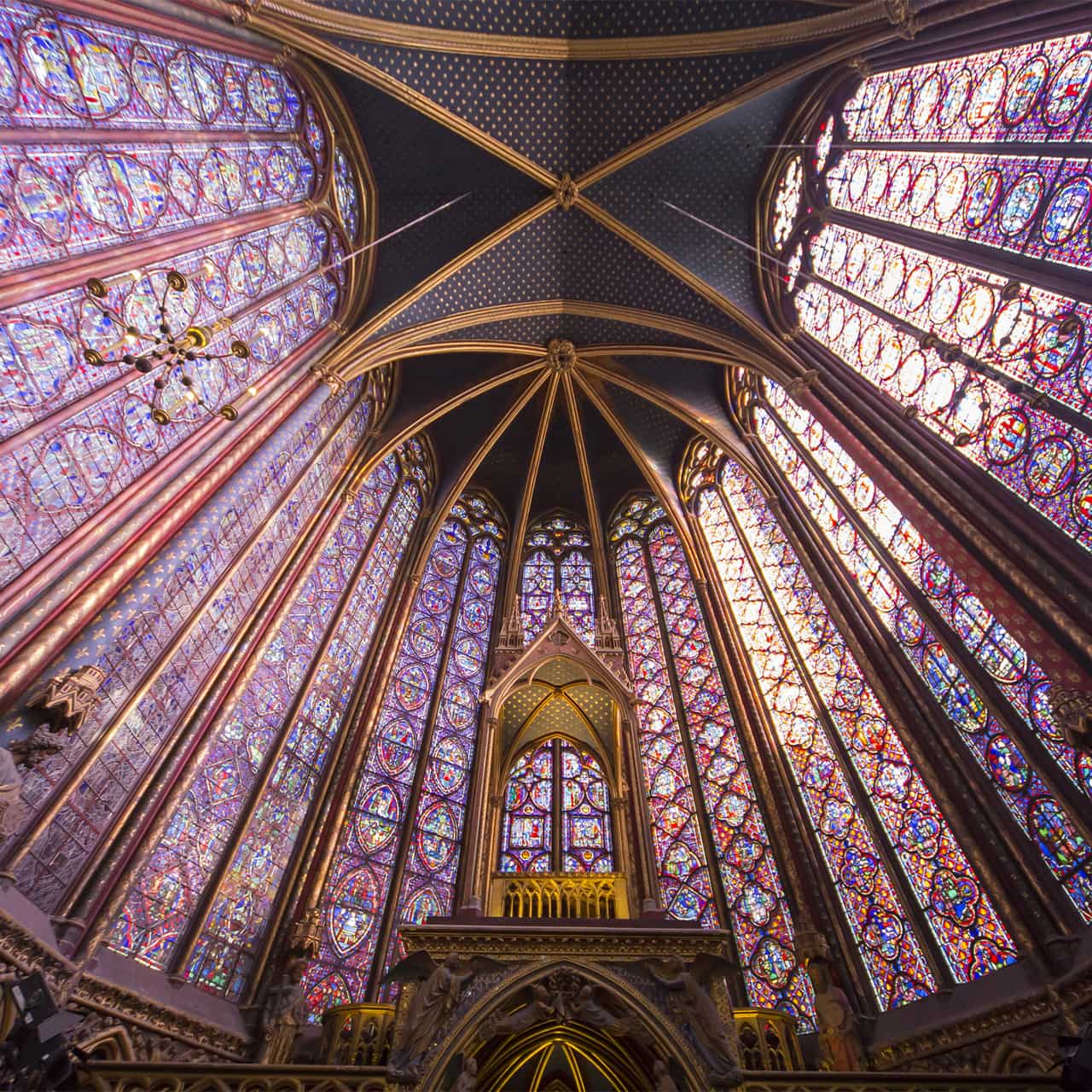
The Sainte-Chapelle is one of the greatest masterpieces of French Gothic architecture, located in the heart of Paris on the Île de la Cité, within the Palais de la Cité complex.
Built in the 13th century, it is world famous for its spectacular polychrome stained-glass windows, which represent one of the most outstanding examples of medieval art. The Sainte-Chapelle was originally built to house the relics of the Passion of Christ, including the Crown of Thorns, purchased by Louis IX, the future St. Louis.
Construction of the Sainte-Chapelle was commissioned by King Louis IX of France in 1242 and was completed in a record time of about 7 years, between 1242 and 1248. Its main purpose was to serve as a private chapel for the royal family and, most importantly, to house the precious relics of the Passion, including the Crown of Thorns, a fragment of the True Cross, and other relics acquired by Louis IX from Baldwin II, Latin emperor of Constantinople. These relics were considered among the most sacred in the Christian world, and their presence in the chapel increased the prestige of the French monarchy.
The Sainte-Chapelle is a perfect example of radiant Gothic architecture, a variant of the Gothic style characterized by intensive use of stained glass and light, slender structures. The chapel is divided into two levels: the lower chapel, intended for palace staff, and the upper chapel, where the magnificent stained glass windows are located and which was reserved for the royal family and their guests.
The stained glass windows of the Sainte-Chapelle
The most outstanding feature of the Sainte-Chapelle are its stained glass windows, which cover an area of 618 square meters and tell in incredible detail scenes from the Bible.
There are as many as 15 windows, each 15 meters high, depicting more than 1,100 biblical scenes from the Old and New Testaments, including Genesis, Exodus, and the Passion of Christ. These stained glass windows are a masterpiece of medieval art and are famous for their brilliance and the artistic quality of the narratives depicted.
The stained glass windows of the Sainte-Chapelle are known for their ability to create an extraordinary lighting effect. When the sun shines through the stained glass windows, the interior of the chapel is filled with a colorful light that transforms the environment into a sea of colors, giving visitors a unique spiritual and sensory experience. The windows are divided into panels detailing biblical episodes and the history of the relics, one of the most comprehensive series of biblical narratives on glass in the world.
The role of the Sainte-Chapelle in history
Besides being an architectural and artistic marvel, the Sainte-Chapelle has played a crucial role in the history of France. It was the place where the relics of Christ’s Passion were kept and venerated, and it represented the centrality of religious and monarchical power in medieval France. The relics were used for royal ceremonies and were integral to the legitimization of the power of the kings of France.
During the French Revolution, many of the relics were dispersed or destroyed, but the Sainte-Chapelle itself survived, although it was badly damaged. In the years that followed, major restorations were carried out, including one of the most significant by Eugène Viollet-le-Duc in the 19th century, which has made it possible to preserve this incredible treasure of Gothic art to the present day.
La Sainte-Chapelle from the Seine
During a cruise on the Seine, the Sainte-Chapelle is visible from the river, located on the Île de la Cité, and offers a unique sight. Although it is partially hidden by the Palais de Justice, its tall Gothic spire and ornate stained-glass windows shine in the sunlight, giving a glimpse of the magnificence that awaits inside. The perspective from the Seine allows you to grasp the strategic location of the Sainte-Chapelle within the historic center of Paris, close to monuments such as Notre-Dame and the Conciergerie.
Admiring it from the river allows you to appreciate the elegance of its architecture and imagine its importance as the religious and political hub of medieval France. This makes the Sainte-Chapelle not only a must-visit attraction, but also a visible symbol of art, faith, and history that continues to influence everyone who sees it.
Notre-Dame de Paris Cathedral
The Masterpiece of French Gothic

ID 167977215 @ Anyaivanova | Dreamstime.com
Notre-Dame de Paris is one of the most beloved symbols of Paris and one of the masterpieces of Gothic architecture. Located in the center of the Île de la Cité, along the Seine River, Notre-Dame Cathedral has fascinated Parisians and visitors from around the world for centuries because of its grandeur, architectural beauty, and profound historical importance. Admiring it during a cruise on the Seine offers a breathtaking view that allows one to grasp the majesty of the cathedral and its significance as the spiritual heart of Paris.
Construction of Notre-Dame Cathedral began in 1163 at the behest of Bishop Maurice de Sully and under the reign of Louis VII. The building was completed in the 14th century, after about 200 years of work, becoming one of the leading examples of Gothic architecture in France and the world. The cathedral has passed through pivotal moments in French history: here, in 1804, Napoleon Bonaparte crowned himself emperor of France, and in 1944 the mass of thanksgiving for the liberation of Paris during World War II was held.
Over the years, Notre-Dame has undergone significant restorations, including one by Eugène Viollet-le-Duc in the 19th century, who added Gothic details and restored many of its damaged parts. The April 15, 2019 fire severely damaged the cathedral’s roof and spire, sparking great emotion around the world and leading to a massive mobilization for its reconstruction. Restoration work is still ongoing, with the goal of restoring Notre-Dame to its original splendor.
The architecture and features of Notre-Dame
Notre-Dame is famous for its Gothic architecture, characterized by its two majestic bell towers, large central rose window, rampant arches, and its intricate sculptures. The 69-meter-high towers offer spectacular views of Paris and are topped by historic bells, including the famous Emmanuel, which dates back to the 18th century.
The large central rose window is one of the cathedral’s most impressive features: at 13 meters in diameter, it represents one of the largest stained glass windows in the world, depicting episodes from the Bible in a unique composition of color and light. On the outside, the famous spires and gargoyles give Notre-Dame a mysterious and fascinating appearance, recalling the Gothic and medieval atmosphere.
Inside, the cathedral is an example of splendor and mysticism, with its high vaulted ceilings, stained glass windows, and statues adorning every corner. The side chapels and high altar are decorated with artwork and sculptures that tell the story and spirituality of Notre-Dame.
Notre-Dame’s significance in French culture and history
Notre-Dame de Paris is not only a cathedral, but a symbol of French identity and culture. Immortalized in Victor Hugo ‘s famous novel “Notre-Dame de Paris” published in 1831, the cathedral became a romantic and mysterious icon that captivated the public and drew attention to its state of preservation, contributing to the restorations of the 19th century.
Hugo’s novel made famous characters such as Quasimodo and Esmeralda, strengthening the cathedral’s connection to the public imagination.
The cathedral has been the scene of important national ceremonies, and is the place where the French gather in times of celebration and mourning. Its symbolic role is also evident in the worldwide mobilization following the 2019 fire, which highlighted how Notre-Dame represents a universal heritage, not only for France but for all humanity.
Notre-Dame from the Seine
During a cruise on the Seine, the view of Notre-Dame de Paris is one of the most exciting moments of the journey. The cathedral’s location on the Île de la Cité makes it visible from different angles, and the perspective from the river allows you to admire the details of the facade and bell towers. Walking past the cathedral, one can appreciate its grandeur and the architectural details that made Notre-Dame a Gothic masterpiece.
At night, the cathedral is illuminated, creating an evocative and romantic atmosphere that turns the walk along Notre-Dame into an unforgettable experience. The lighting enhances the rose window and sculptures, allowing the cathedral to be appreciated in all its beauty even after dark.
Institut de France
The cradle of French culture and knowledge
ID 78999237 @ Meunierd | Dreamstime.com
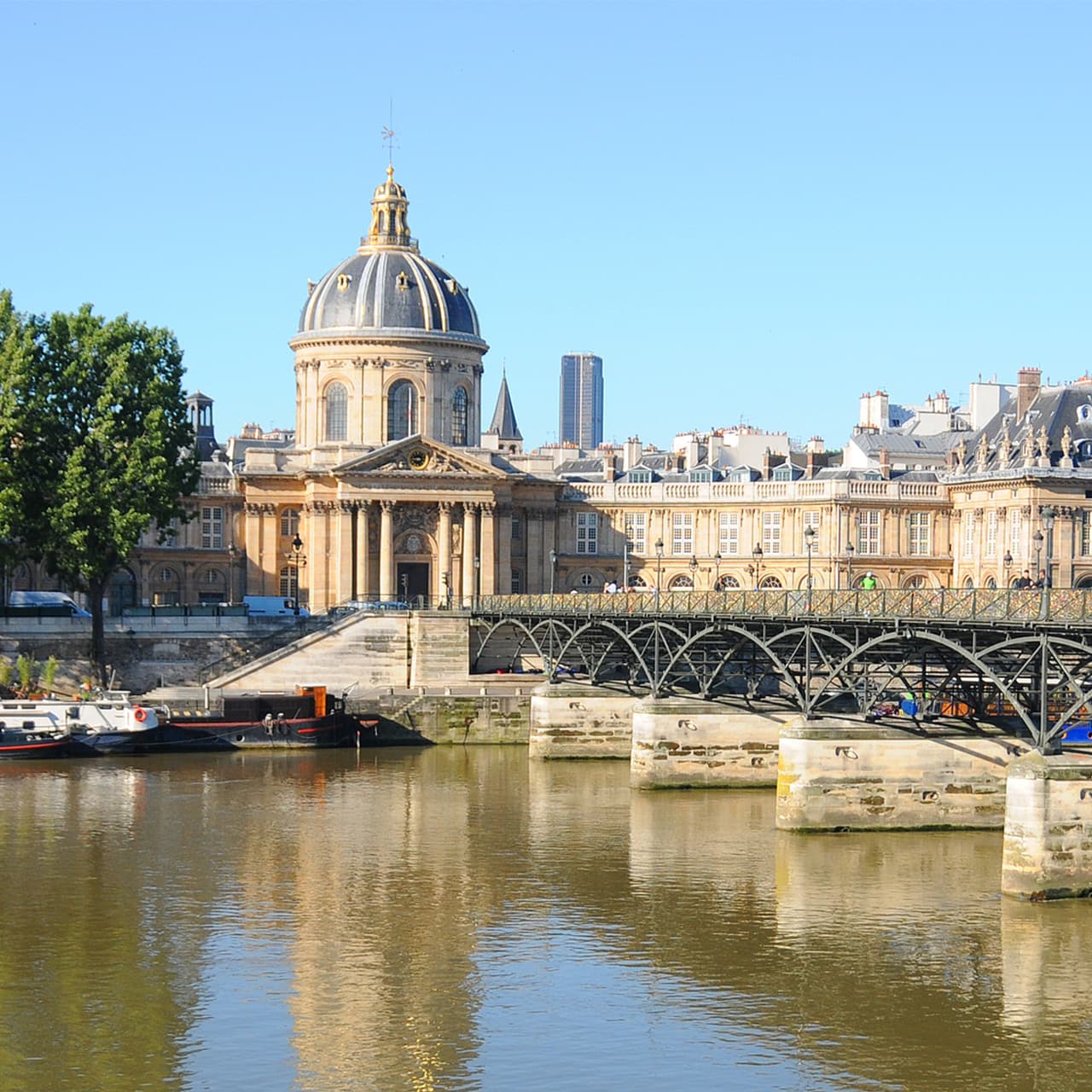
The Institut de France is one of the most prestigious and important places for culture and knowledge in France.
Located on the left bank of the Seine, opposite the Louvre Museum and next to the Pont des Arts, this historic building houses the country’s five main academies, including the famous Académie Française. Founded to promote the sciences, arts and letters, the Institut de France is a symbol of intellectual excellence and represents the heart of French knowledge. During a cruise on the Seine, a view of the Institut de France is one of the most fascinating moments, thanks to its classical architecture and prestigious history.
The Institut de France was established in 1795 during the French Revolution as part of a reorganization of national education and culture. It was created to bring together the country’s leading intellectual academies and to promote the advancement of knowledge and art. The building in which it is housed was built in the 17th century as the Collège des Quatre-Nations, commissioned by Cardinal Mazarin. Upon his death, Mazarin left his estate to finance the construction of a college dedicated to students from the French regions that had joined France under his rule.
Designed by architect Louis Le Vau, the Collège des Quatre-Nations was completed in 1688 and became one of the masterpieces of classical Parisian architecture. With the founding of the Institut de France, the building was intended to house the main French academies and was thus transformed into a symbol of the country’s culture and intellectual excellence.
The Academies of the Institut de France
The Institut de France houses five academies, including the famous Académie Française, founded in 1635 by Cardinal Richelieu. The Académie Française is responsible for regulating and preserving the French language and is responsible for compiling the famous Dictionary of the French Language. Its members, known as “immortals,” are elected for life and represent some of the most eminent figures in French literature and the arts.
In addition to the Académie Française, the Institut de France also includes the Académie des Inscriptions et Belles-Lettres, the Académie des Sciences, the Académie des Beaux-Arts, and the Académie des Sciences Morales et Politiques. Each academy is dedicated to a specific field and contributes to the promotion of their respective disciplines, making the Institut de France one of the most influential cultural and intellectual institutions in Europe.
The architecture of the Institut de France
The Institut de France building is a remarkable example of classical French architecture. Its curved facade and majestic central dôme are easily recognizable and form one of the architectural landmarks along the Seine. The dôme, or dome, is tall and imposing, and its elegant shape dominates the landscape of the left bank. Architect Louis Le Vau created a refined and harmonious work, characterized by columns and arches that give the complex a solemn and prestigious appearance.
Inside, the building retains elegant and historic halls, including the Salle des Séances (Sitting Room), where members of theAcadémie Française gather. The interiors are decorated with frescoes, statues and busts celebrating the most distinguished figures in French cultural history. The Institut de France is open to the public only on special occasions, such as Heritage Days, offering visitors a rare opportunity to admire its interiors and learn more about its role in national culture.
The Institut de France from the Seine
During a cruise on the Seine, the Institut de France is one of the most striking spots on the route. The view of its curved facade and dome silhouetted against the Parisian sky is particularly fascinating, especially at sunset. The building’s location, opposite the Louvre and near the Pont des Arts, makes the Institut de France a focal point of the river landscape.
At night, the Institut de France is illuminated by soft lights that enhance the beauty of its façade and dôme, creating an elegant and refined atmosphere. Passing along this monument while cruising on the Seine gives a full view of its historical and architectural importance and is one of the most romantic and fascinating moments of navigation.
Hôtel de Ville
The historical and political center of Paris

ID 52709149 @ Pavel Kavalenkau | Dreamstime.com
The Hôtel de Ville is one of the most important and impressive buildings in Paris. Located in the heart of the capital, along the right bank of the Seine, it is the seat of the municipal administration of Paris and houses the Mayor’s office. With its magnificent neo-Renaissance style architecture and long history, the Hôtel de Ville is one of the city’s most iconic landmarks and is the center of Paris‘s political and social life. During a cruise on the Seine, the view of the Hôtel de Ville is one of the highlights, thanks to its privileged location and extraordinary architectural beauty.
The history of the Hôtel de Ville dates back to 1357, when the provost of Paris, Étienne Marcel, purchased the original building to house the seat of the municipal administration. However, the current building was largely constructed in the 16th century during the reign of Francis I, who commissioned architects Dominique de Cortone and Pierre Chambiges to create a new palace in the Renaissance style.
The Hôtel de Ville has gone through several historical periods, and suffered severe damage during the Paris Commune in 1871, when it was burned and almost completely destroyed. It was rebuilt between 1873 and 1892 by architects Théodore Ballu and Édouard Deperthes in the neo-Renaissance style, retaining the original structure but enriching it with decorations and sculptures. Today, the Hôtel de Ville is one of the best examples of neo-Renaissance architecture in France and a symbol of the city’s resilience and history.
The architecture of the Hôtel de Ville
The Hôtel de Ville is a masterpiece of neo-Renaissance architecture, with a richly decorated facade that includes statues, columns, towers, and ornamental details that celebrate the history and culture of Paris. The main facade is adorned with 136 statues representing distinguished figures in French history and culture, such as Voltaire, Jean-Jacques Rousseau, and Eugène Delacroix.
In the center of the building is a clock tower, topped by a dome that dominates the panorama of the right bank. The interior of the Hôtel de Ville is equally opulent, with large rooms decorated with paintings, sculptures, and tapestries that tell the story of the city. One of the most prominent rooms is the Salle des Fêtes, a ballroom reminiscent of the famous Gallery of Mirrors in Versailles in its grandeur and decorative style.
The Hôtel de Ville as the center of political and cultural life
In addition to being the seat of city government, the Hôtel de Ville is a central place for the political and social life of Paris. It is where important official events, ceremonies and political meetings are held, and where key decisions are made for the management of the city. The building also hosts art exhibitions, cultural events, and celebrations that involve Parisian citizens and visitors.
The large square in front, Place de l’Hôtel de Ville, is a popular gathering space, used for public events, concerts, Christmas markets and other cultural events. During winter, the square hosts an ice skating rink, while in summer, areas are set up for recreation and relaxation. The Hôtel de Ville is thus not only a political symbol, but also a dynamic center reflecting the spirit of the city and community participation.
The Hôtel de Ville from the Seine
During a cruise on the Seine, the Hôtel de Ville stands out for its majesty and its central location in the Paris cityscape. The view from the Seine allows one to appreciate the grandeur of the building and the details of its architecture. The walkway along the river offers a unique perspective on this imposing building and allows one to grasp its importance as the center of Parisian life.
At night, the Hôtel de Ville is illuminated by lights that enhance its architectural beauty, creating a spectacular effect. The night lighting highlights the details of the facade and the statues, making the passage along the Hôtel de Ville one of the most fascinating moments of an evening cruise on the Seine.
Seine Cruise Tickets
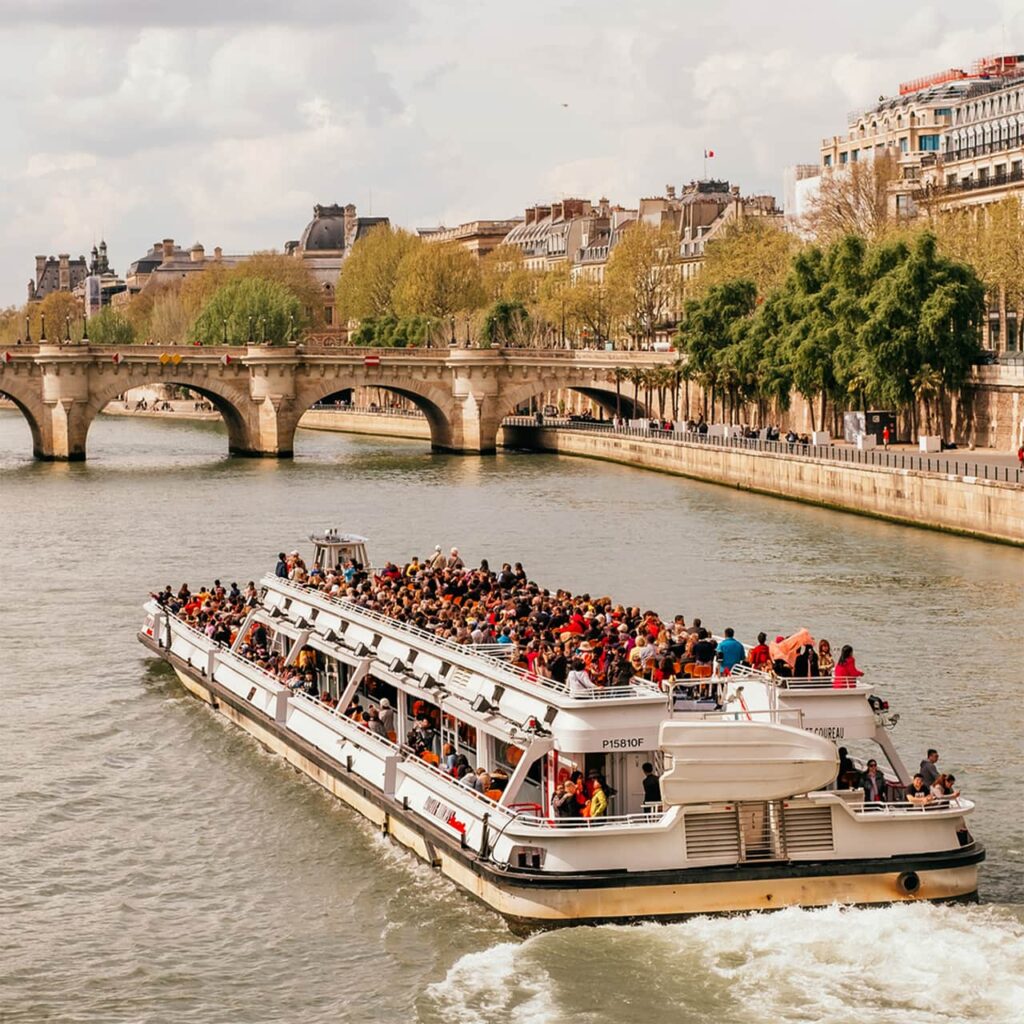
A tour on the Seine between bridges and historic buildings. The sightseeing cruise is perfect for couples, friends and families visiting Paris.
You can cancel up to 24 hours before your visit
Place du Vert-Galant
A romantic corner on the Île de la Cité
ID 178634256 @ Molotok007 | Dreamstime.com
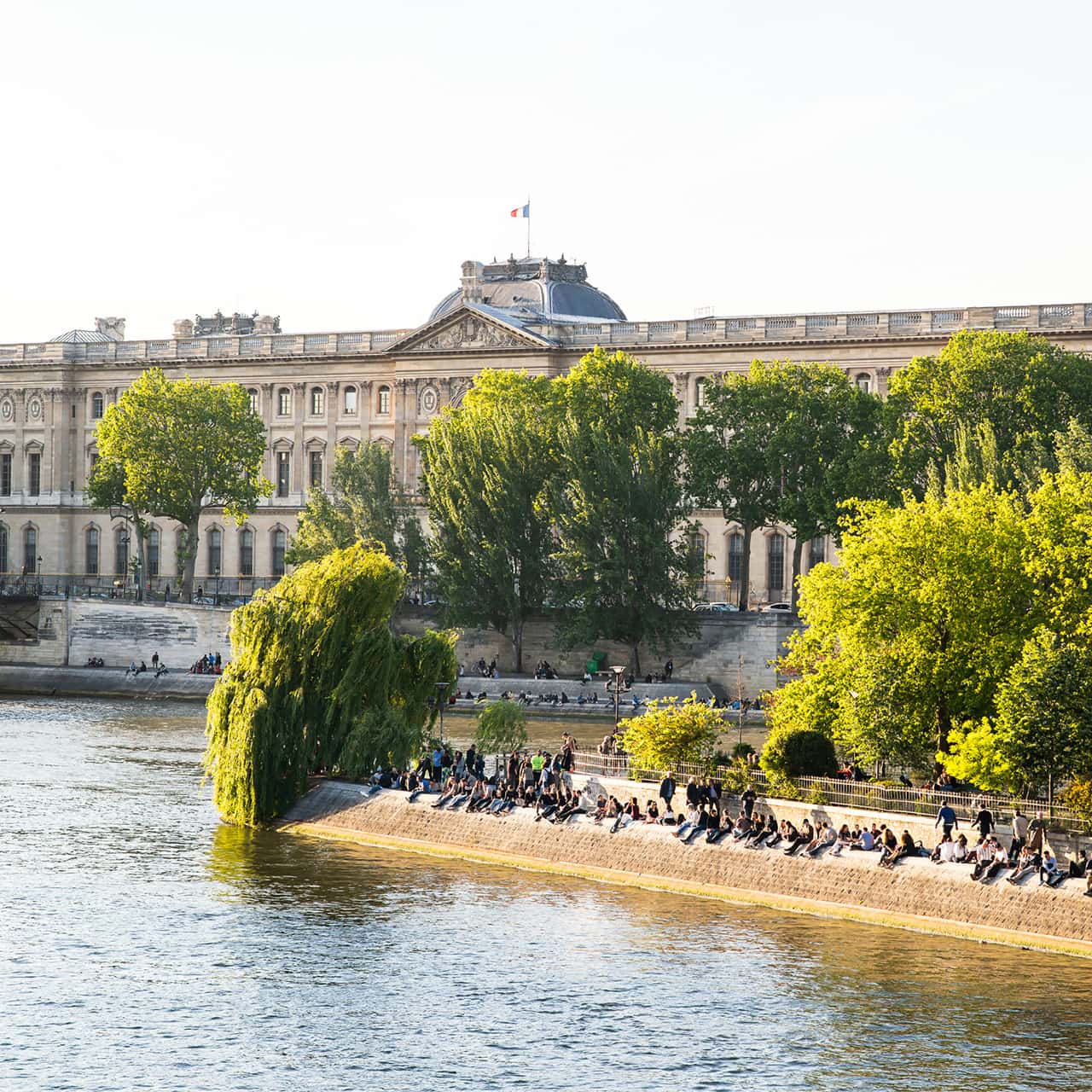
Place du Vert-Galant is one of the most charming and romantic places in Paris, located at the western end of the Île de la Cité, just below the Pont Neuf. This small garden, surrounded by the Seine, is known for its peaceful atmosphere and panoramic views of the river and surrounding bridges. The name “Vert-Galant” is a tribute to Henry IV, the French king known for his gallant spirit and reputation as a great seducer. Place du Vert-Galant is one of the most picturesque spots on a cruise on the Seine, offering a unique glimpse of the city and its history.
The Place du Vert-Galant owes its name to Henry IV, ruler of France from 1589 to 1610, known for his affable character and his many love affairs. The expression “Vert-Galant” refers precisely to his romantic vivacity and charm. After his death, an equestrian statue of Henry IV was erected on the Pont Neuf, and the garden extending under the bridge became known as the Place du Vert-Galant.
This small artificial island was created by filling in alluvial soils and became a public park accessible to citizens. In the centuries that followed, Place du Vert-Galant became a popular place for Parisians and visitors because of its central location and intimate atmosphere. Today, it is a favorite spot for romantic walks and a gathering place for those seeking a quiet corner in the midst of the pulsating heart of Paris.
The beauty of the garden and the view of the Seine River
Place du Vert-Galant features a small garden that offers lush vegetation and a relaxing environment. Here, at the foot of the Pont Neuf, there are trees, benches, and a path that allows you to stroll along the Seine and enjoy the view. The garden offers 360-degree views of the river and surrounding bridges, with spectacular glimpses of monuments such as the Louvre Museum and the Institut de France.
During spring and summer, Place du Vert-Galant fills with flowers and greenery, making it a perfect natural retreat in the center of the city. The contrast between the vibrancy of the Île de la Cité and the tranquility of the garden creates a unique atmosphere, making Place du Vert-Galant an ideal destination for those who want to escape the city bustle and relax surrounded by the beauty of Paris.
Place du Vert-Galant from the Seine
During a cruise on the Seine, Place du Vert-Galant is one of the most striking places to admire. From the river, you can appreciate the garden’s strategic location at the end of the Île de la Cité, surrounded by the waters of the Seine and dominated by the Pont Neuf. The view of the garden from the boat offers a unique perspective, highlighting its central location and the timeless charm of this corner of Paris.
At night, soft lighting makes Place du Vert-Galant an even more magical and romantic place. The lights reflect on the waters of the Seine, creating an enchanting atmosphere that makes every passage beside the garden an unforgettable experience for anyone who is cruising along the river.
Pont des Arts
The bridge of artists and lovers
ID 43710787 @ Shchipkova Elena | Dreamstime.com
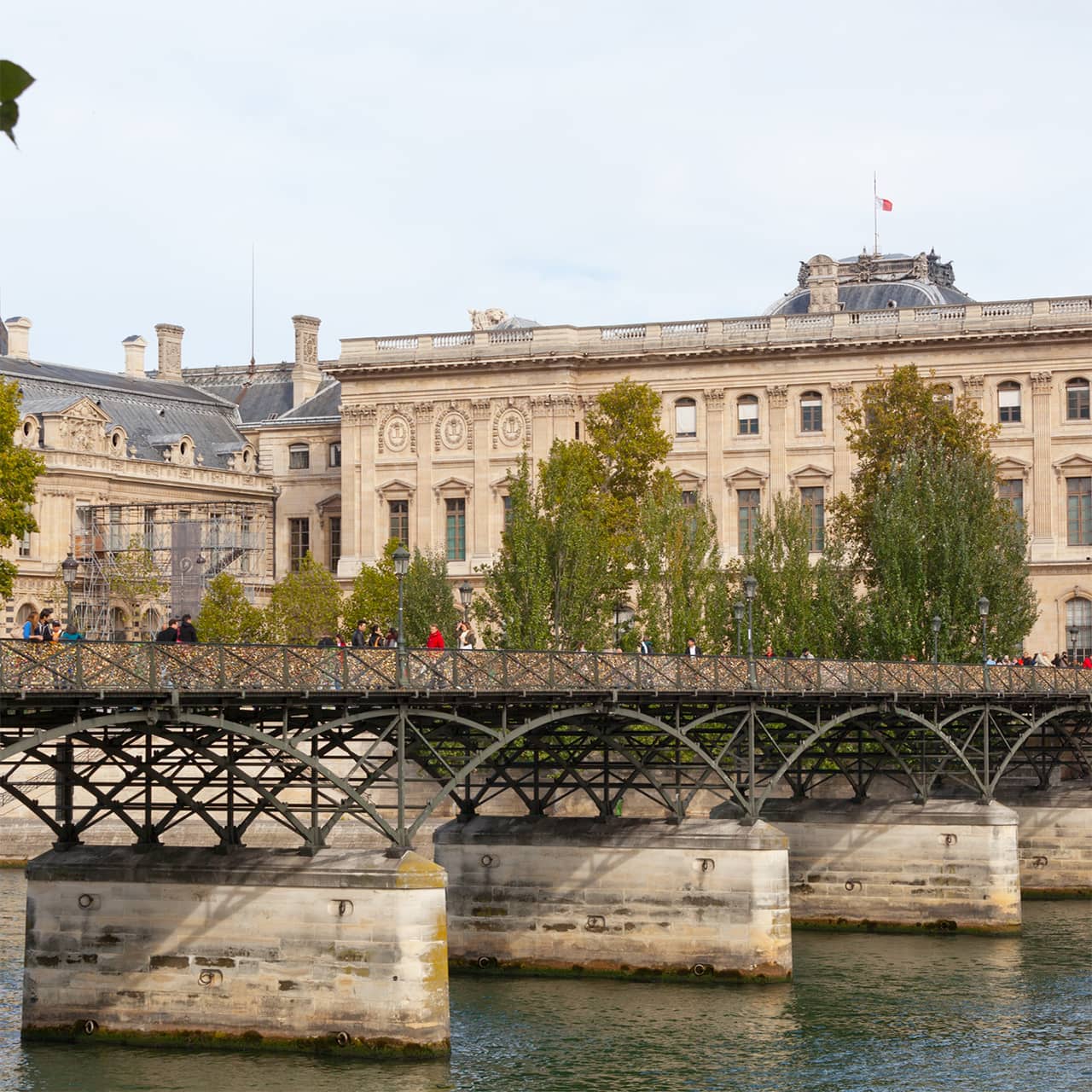
The Pont des Arts is one of the most famous and romantic bridges in Paris, known for its beauty and symbolic role as “artists’ bridge” and “lovers’ bridge.” It connects the left bank of the Seine, where the Institut de France is located, with the right bank in front of the Louvre Museum. This pedestrian bridge offers panoramic views of the Seine and the city, and is one of the most iconic places for visitors to Paris and anyone who wants to enjoy a romantic stroll. During a cruise on the Seine, the Pont des Arts is one of the most fascinating vantage points, with its elegant structure and historical and cultural significance.
The history of the Pont des Arts
The Pont des Arts was built between 1801 and 1804 during the reign of Napoleon Bonaparte, and was the first bridge in Paris to be made entirely of metal. Designed by engineers Louis-Alexandre de Cessart and Jacques Dillon, the bridge was conceived as a pedestrian walkway and quickly became popular with artists, intellectuals, and Parisian citizens. It was originally called the “Passerelle des Arts” and connected the Palais des Arts, now the Louvre Museum, with theInstitut de France.
In 1976, the Pont des Arts suffered serious damage from a collision with a barge and had to be demolished. It was then rebuilt between 1981 and 1984 following the original design, preserving its elegant and light appearance. Today, the bridge is reserved for pedestrians and offers a unique space for strolling and admiring the Parisian skyline.
The Lovers’ Bridge
Over the years, the Pont des Arts has become a symbol for lovers around the world. Until 2015, the bridge was known for the famous“love locks” that couples hung on the railings to symbolize their eternal love. Lovers would write their names on a padlock, clip it to the bridge and throw the key into the Seine as a symbolic gesture. However, the increasing weight of the padlocks began to damage the bridge’s structure, and in 2015 the City of Paris decided to remove them to preserve its stability.
Despite the removal of the padlocks, the Pont des Arts remains a romantic place and a meeting point for couples and artists. The unique atmosphere of the bridge, combined with its panoramic views of the Seine, the rooftops of Paris, and the nearby Louvre and Institut de France, continues to make it a favorite spot for strolls and declarations of love.
The architecture and design of the Pont des Arts
The Pont des Arts is a light and airy metal walkway consisting of seven arches spanning some 155 meters. Its design features a wrought iron structure that creates a visual effect of lightness and elegance. The bridge provides a wide and open platform that allows pedestrians to stop, walk freely and enjoy the panoramic view without hurrying.
The structure of the Pont des Arts fits harmoniously into the urban landscape of Paris and allows uninterrupted views of surrounding monuments, such as the Musée d’Orsay and Notre-Dame Cathedral. The bridge’s central location and architectural style make the Pont des Arts one of the city’s most iconic walkways and a favorite destination for Parisians and tourists alike.
The Pont des Arts from the Seine
During a cruise on the Seine, the Pont des Arts is one of the most recognizable and striking bridges. From the river, you can admire its light structure and the continuous flow of people crossing it, creating a lively and poetic atmosphere. The bridge’s location, between the Institut de France and the Louvre, makes it a central landmark for those sailing along the Seine.
At night, the Pont des Arts is illuminated by soft lights that create a romantic and magical effect, with the reflection of the lights silhouetted against the waters of the river. This moment is one of the most romantic and unforgettable on an evening cruise, and the view of the illuminated bridge perfectly represents the timeless charm of Paris.
Frequently asked questions
The classic route of the Seine cruises through the heart of Paris, passing the major monuments: Eiffel Tower, Musée d’Orsay, Louvre, Notre-Dame Cathedral, and Pont Alexandre III. The navigation offers a unique perspective on the city, with departure and arrival usually from the same point.
Duration varies depending on the type of cruise. Standard sightseeing cruises last about 1 hour, while those with dinner or lunch can last from 1 hour and 30 minutes up to 2 1/2 hours. Batobus cruises, on the other hand, operate as shuttles with flexible durations.
One-hour cruises are offered by companies such as Bateaux Parisiens, Bateaux Mouches, Vedettes de Paris, and Vedettes du Pont-Neuf. The main departure points are near the Eiffel Tower and the Pont-Neuf. You can purchase tickets online or directly on site.
The price for a basic sightseeing cruise ranges from 15 to 20 euros for adults, with discounts for children and family packages. Dinner cruises start at about 60 euros and can exceed 100 euros depending on the menu and place on board. Batobus offers day passes starting at 19 euros.
Sightseeing cruises typically depart every 30-60 minutes, from 10:00 am until 22:00. Dinner cruises have fixed times, often departing around 20:00. Schedules may vary by season and company, so it is always recommended to consult the official website.
Conclusions
A cruise on the Seine is one of the most fascinating ways to discover Paris and its iconic monuments. From the imposing Eiffel Tower to the elegant Grand Palais, via historic bridges such as the Pont Neuf and the romantic Pont des Arts, each stop represents a journey into the history and culture of the French capital.
Attractions such as the Île de la Cité with the majestic Notre-Dame de Paris, and the Gothic beauty of the Sainte-Chapelle, offer a plunge into the medieval past, while the Louvre and the Institut de France testify to France’s artistic and intellectual greatness.
The cruise allows you to view Paris from a unique perspective, where the majesty of the Hôtel des Invalides, the quiet of the Place du Vert-Galant, and the historic Place de la Concorde parade before your eyes, illuminated by daylight or the nighttime charm of the city lights.
Every corner along the Seine tells a story, and the romantic and timeless atmosphere of Paris envelops visitors in an experience that is both poetic and memorable.
Seine River Cruise Tickets
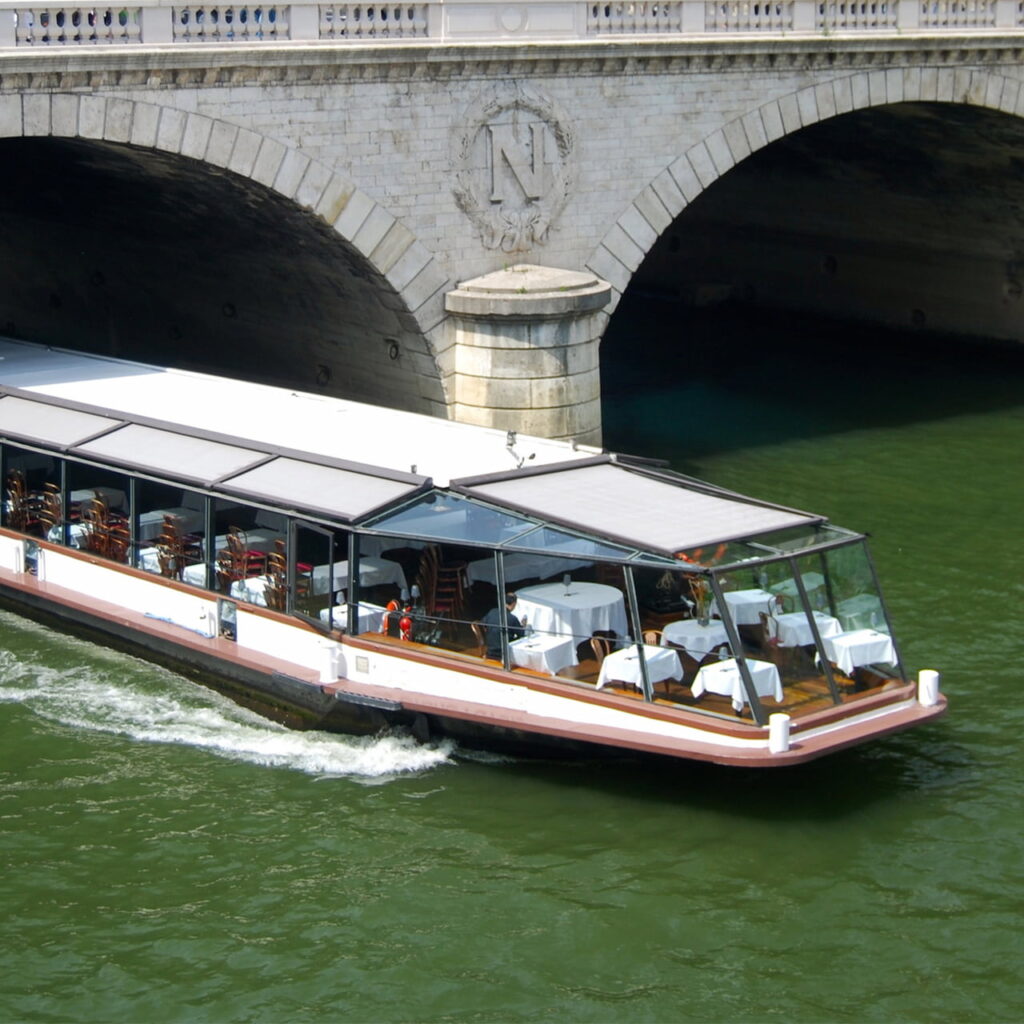
Step aboard, relax and admire the Ville Lumière from a unique perspective. The classic cruise is a must-see in Paris!
You can cancel up to 24 hours before your visit
